 Albania
 Argentina
 Australia
 Austria
 Belgium
 Bosnia and Herzegovina
 Brazil
 Bulgaria
 Canada
 Chile
Chile
 Colombia
 Croatia
 Czech Republic
 Denmark
 Estonia
 Finland
 France
 Germany
 Greece
 Hungary
 Ireland
 Italy
Italy
 Latvia
 Lithuania
 Luxembourg
 Mexico
 Moldova
 Montenegro
 Netherlands
 New Zealand
 North Macedonia
 Norway
 Philippines
 Poland
 Portugal
 Romania
 Serbia
 Slovakia
 Slovenia
 South Africa
 Spain
Spain
 Sweden
 Switzerland
 Turkey
 Ukraine
 United Kingdom
 United States of America



How to choose cymbals
You have the kit and the sticks, and the whole thing still sounds cheap. Nine times out of ten the cymbals are to blame. They are the most expensive pieces of metal a drummer buys and the first thing an audience hears.
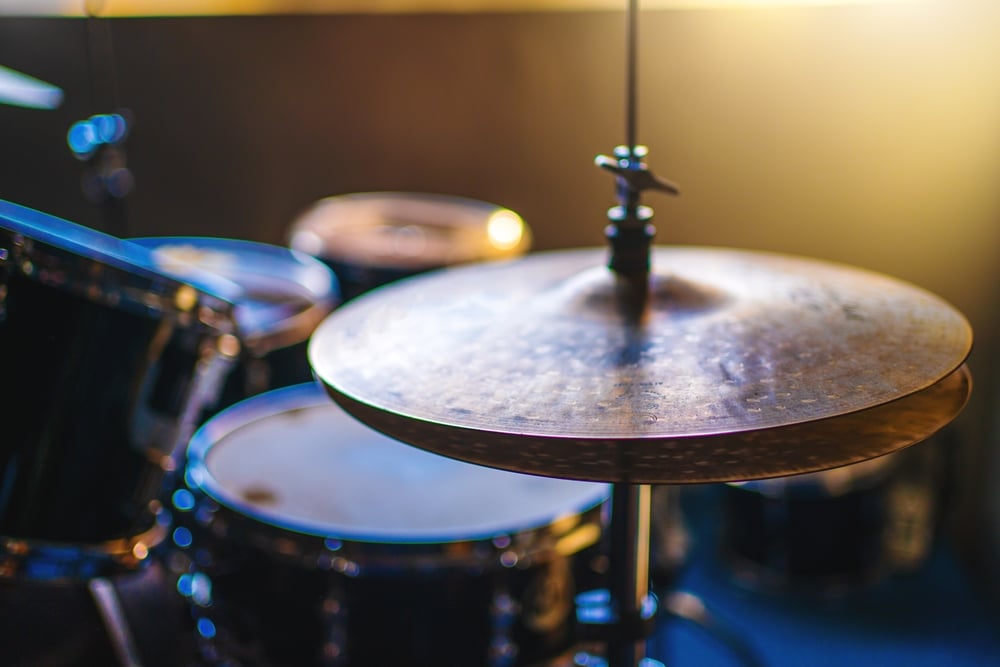
Why two cymbals of the same size sound completely different
Two eighteen-inch crashes can cost forty euros or three hundred and sound like two different instruments. The difference is not the diameter or the thickness of the metal, but the alloy they are made of and how many hands worked on them before they reached the shop. That is exactly why cymbals cannot be picked from a spec table the way you would pick an audio interface. You are choosing a sound, not a number.
To make sense of it you need to know what happens to a piece of bronze during manufacturing. Every step adds or removes something specific, and once you understand it you stop reading series names and start listening.
To make sense of it you need to know what happens to a piece of bronze during manufacturing. Every step adds or removes something specific, and once you understand it you stop reading series names and start listening.
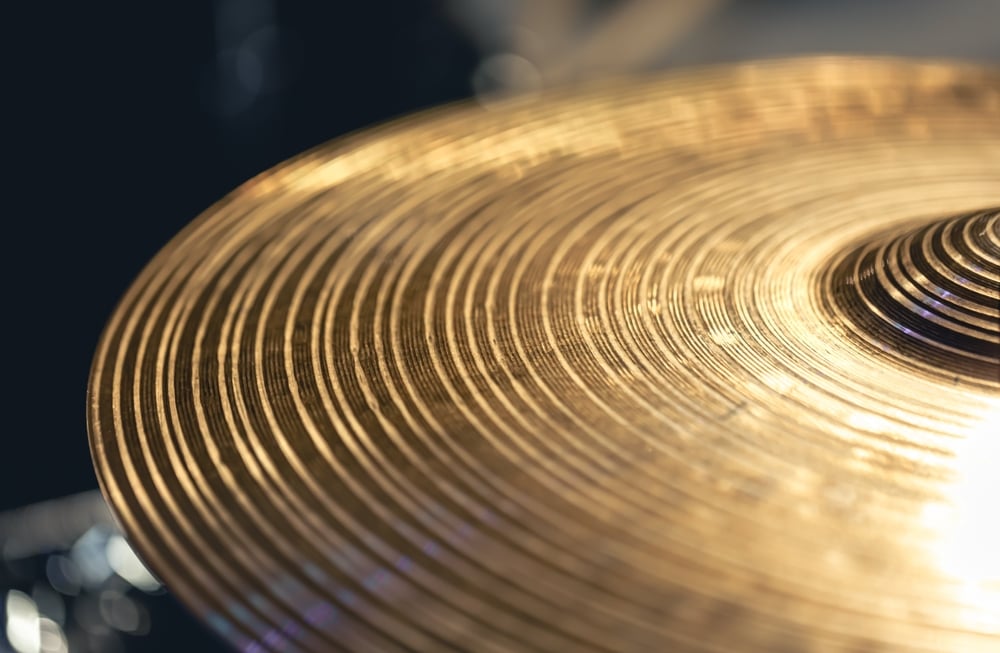
How a cymbal is made and what that does to the sound
Cast or sheet
It all starts with whether the cymbal is cast or cut from a finished sheet. Cheaper pieces are pressed out of a large rolled sheet of metal with the same structure across its whole area. The result is cheap, predictable and consistent, so two cymbals from the same series sound practically identical. For a beginner that is no drawback, quite the opposite, you know exactly what you are buying.
More expensive cymbals are cast one at a time into a mould and then rolled and heated repeatedly. This arranges the crystals in the metal so the finished cymbal can vibrate in far more modes at once. That is the whole reason professional lines sound more complex, and also why two pieces from the same series differ. It is exactly why experienced drummers turn up at the shop with their own sticks.
More expensive cymbals are cast one at a time into a mould and then rolled and heated repeatedly. This arranges the crystals in the metal so the finished cymbal can vibrate in far more modes at once. That is the whole reason professional lines sound more complex, and also why two pieces from the same series differ. It is exactly why experienced drummers turn up at the shop with their own sticks.
Hammering
Once the bell is formed, hammering comes next. Thousands of blows are pressed into the surface, by hand or by machine, and each one disrupts the regularity of the material. It sounds like damage but it is the opposite. A perfectly smooth disc would vibrate in clean, mathematically regular modes and sound more like a gong. Hammering breaks that regularity, the pitch blurs into a mass of overtones, and the cymbal gains what drummers call darkness and complexity.
Machine hammering places the marks in a regular grid and gives a cleaner, brighter result. Hand hammering is irregular, every piece is different and the sound tends to be darker and more layered. That is why hand-hammered lines such as Meinl Byzance or Zildjian K cost more, and why players reach for them in jazz and more acoustic music.
Machine hammering places the marks in a regular grid and gives a cleaner, brighter result. Hand hammering is irregular, every piece is different and the sound tends to be darker and more layered. That is why hand-hammered lines such as Meinl Byzance or Zildjian K cost more, and why players reach for them in jazz and more acoustic music.
Lathing
The next step is lathing, cutting concentric grooves into the surface. They are not decoration. The lathe removes material, changes the thickness along the radius and with it the flexibility of each band. A heavily lathed cymbal tends to be brighter, more open and to sustain longer.
What happens when lathing is skipped is more interesting. An unlathed, so-called raw cymbal keeps its original thicker layer and sounds dry, shorter and dirtier. That sound is used deliberately in modern rock and metal today and you will also find it among effect cymbals. Many lines combine both, with part of the surface lathed and part left raw.
What happens when lathing is skipped is more interesting. An unlathed, so-called raw cymbal keeps its original thicker layer and sounds dry, shorter and dirtier. That sound is used deliberately in modern rock and metal today and you will also find it among effect cymbals. Many lines combine both, with part of the surface lathed and part left raw.
Profile, thickness and bell
The last three factors shape the sound most visibly. The profile is the curvature from bell to edge, and the flatter it is the lower the cymbal sounds and the longer it takes to open up. The thickness tapers towards the edge and that taper decides how quickly the cymbal responds to a stroke. A thin edge ripples immediately and gives you a wave of sound, a thick one needs a harder hit but cuts through the whole band and will not disappear under the guitars.
The bell is a chapter of its own. A larger, taller bell adds volume and a sharp, defined ping used in rock choruses. A smaller bell blends into the rest of the cymbal and suits situations where you do not want to stand out. When you try a ride in the shop, play the bell as well as the bow, because in practice you will use both.
The bell is a chapter of its own. A larger, taller bell adds volume and a sharp, defined ping used in rock choruses. A smaller bell blends into the rest of the cymbal and suits situations where you do not want to stand out. When you try a ride in the shop, play the bell as well as the bow, because in practice you will use both.
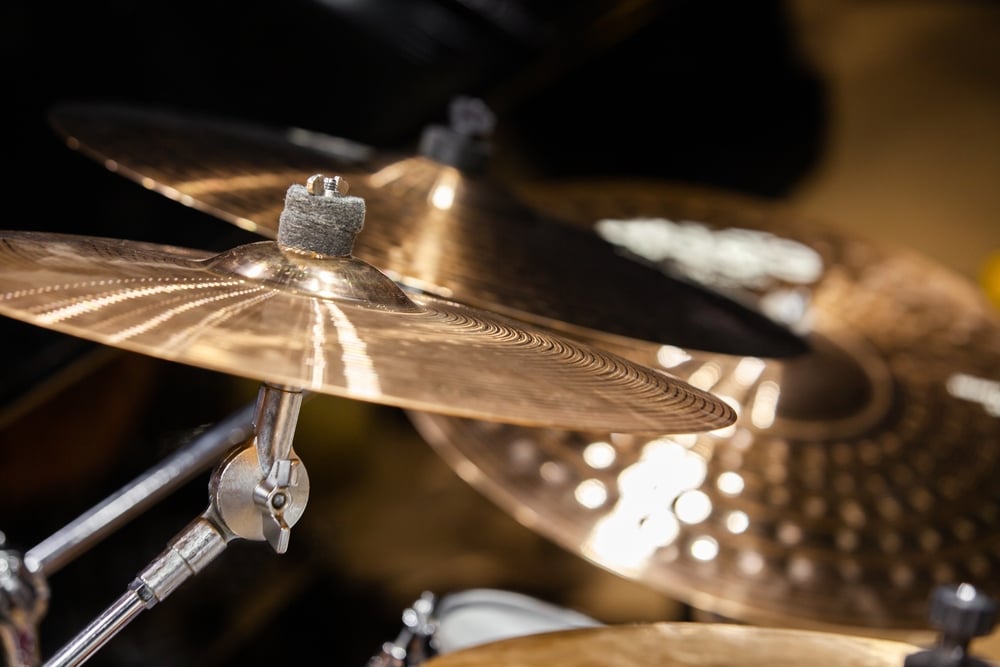
What types of cymbals are there
The core is a hi-hat, a crash and a ride, and that is also the order in which it makes sense to buy them. Everything else is an add-on that solves a specific need.
If you are buying for the first time, do not assemble the set piece by piece. Cymbal packs contain a hi-hat, a crash and a ride together and work out considerably cheaper than three separate cymbals, and beginner packs are built for exactly this purpose.
| Type | Common size | What it does | Buying order |
|---|---|---|---|
| Hi-hat | 13" – 15" | keeps time, opens and closes the groove | first, you use it most |
| Crash | 16" – 18" | accents, opening a chorus | second |
| Ride | 20" – 22" | steady time instead of the hi-hat | third |
| Crash-ride | 18" – 20" | a compromise when you cannot afford both | if money is tight |
| Splash | 8" – 12" | short, high accent | later |
| China | 16" – 20" | dirty, aggressive accent | later |
| Effect | various | stacks, trash, bell effects | for advanced players |
If you are buying for the first time, do not assemble the set piece by piece. Cymbal packs contain a hi-hat, a crash and a ride together and work out considerably cheaper than three separate cymbals, and beginner packs are built for exactly this purpose.
How many cymbals do you actually need
The answer is not set by ambition but by three practical things, and none of them is the price of the cymbal itself.
The first is the hardware you already own. Every crash, china and splash needs its own boom stand, and those cost money. If you own two stands there is no point buying four cymbals, because you have nowhere to hang them. Arms and attachments that clamp onto an existing stand solve part of the problem, but even there you have to watch how much one tube will carry. The hi-hat is a case of its own, because it needs a dedicated hi-hat stand with a pedal, and that is not always included in hardware packs.
The second is genre. A jazz drummer is set for life with three pieces and will spend most of the night on the ride and the hi-hat. A metal player needs at least two crashes for fast alternation and a china is basic equipment rather than decoration. In pop and worship the priority is that the kit does not get louder than the vocal, so thinner and smaller pieces win.
The third is your own preference and nobody can plan that for you. There are drummers who play stadiums on four cymbals and drummers with fifteen around them. Neither approach is better, only different. The sensible route is to start with three, play them for six months and add only what you genuinely miss on a specific song.
The first is the hardware you already own. Every crash, china and splash needs its own boom stand, and those cost money. If you own two stands there is no point buying four cymbals, because you have nowhere to hang them. Arms and attachments that clamp onto an existing stand solve part of the problem, but even there you have to watch how much one tube will carry. The hi-hat is a case of its own, because it needs a dedicated hi-hat stand with a pedal, and that is not always included in hardware packs.
The second is genre. A jazz drummer is set for life with three pieces and will spend most of the night on the ride and the hi-hat. A metal player needs at least two crashes for fast alternation and a china is basic equipment rather than decoration. In pop and worship the priority is that the kit does not get louder than the vocal, so thinner and smaller pieces win.
The third is your own preference and nobody can plan that for you. There are drummers who play stadiums on four cymbals and drummers with fifteen around them. Neither approach is better, only different. The sensible route is to start with three, play them for six months and add only what you genuinely miss on a specific song.
What size cymbal should you choose
A bigger diameter means a lower pitch, longer sustain and more volume, a smaller one is higher, faster and dies away sooner. On a hi-hat the size also decides how sharp the closed stroke sounds.
| Size | Character | Where it fits |
|---|---|---|
| 13" hi-hat | sharp, fast | jazz, funk, small rooms |
| 14" hi-hat | all-rounder | if in doubt, take this |
| 15" hi-hat | darker, heavier | rock, bigger stages |
| 16" crash | fast, short | punk, metal, fast genres |
| 18" crash | fuller, longer | rock, pop, all-round |
| 20" ride | defined stick sound | jazz, studio |
| 22" ride | carries, strong bell | rock, live shows |
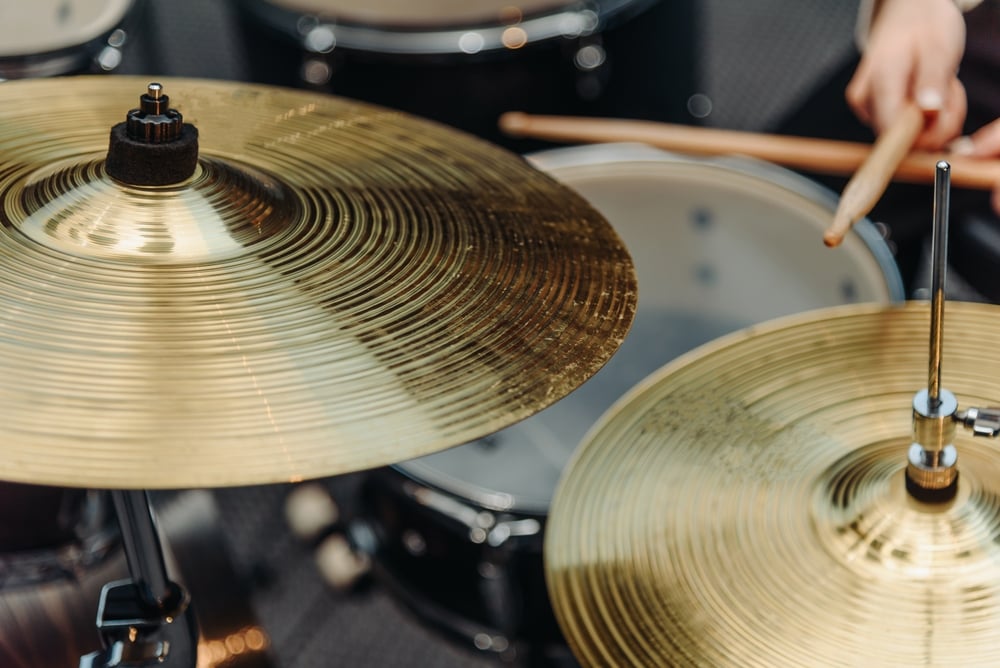
What are cymbals made of
The alloy is the one figure that hints at the price before you look at the tag. As the tin content rises, so does the metal's ability to vibrate in more complex modes, but it also becomes more brittle and harder to work.
One widespread myth needs correcting here. B8 does not automatically mean a cheap cymbal. The Paiste 2002 line, on which a large part of classic seventies rock was built and which professionals still use, is made of B8. The alloy determines the character of the sound, not the quality of the instrument. B20 is more complex, B8 is louder and more cutting, and which is better depends on what you play.
| Alloy | Composition | Sound | Price |
|---|---|---|---|
| Brass | copper and zinc | simple, flat, short | cheapest |
| B8 bronze | 92% copper, 8% tin | bright, cutting, loud | mid |
| B20 bronze | 80% copper, 20% tin | complex, warm, longer sustain | higher |
One widespread myth needs correcting here. B8 does not automatically mean a cheap cymbal. The Paiste 2002 line, on which a large part of classic seventies rock was built and which professionals still use, is made of B8. The alloy determines the character of the sound, not the quality of the instrument. B20 is more complex, B8 is louder and more cutting, and which is better depends on what you play.
Which cymbals for which style
| Style | What to look for | Typical lines |
|---|---|---|
| Rock and pop | medium-weight B20, 14" hi-hat, 18" crash, 20" ride | Zildjian A, Sabian AA |
| Metal | thicker and louder pieces, a china, fast crashes | Zildjian A Custom, Meinl Classics Custom |
| Jazz | thin, dark, hand-hammered, a 20" ride with a strong bell | Zildjian K, Sabian HH |
| Funk and fusion | fast, sharp, splashes and stacks | Sabian HHX, Meinl Byzance |
| Acoustic and worship | thin and quiet, low volume | thin B20 and low-volume lines |
Treat this as a starting point, not a rule. There are more drummers playing metal on jazz cymbals than you would expect, and sometimes that is exactly what makes a band recognisable.
Which brand is the best
There is no best, only the best for you, and four names cover most of the market.
Zildjian is the oldest of the four and its A line is probably the most recorded cymbal in the history of popular music. The K line is darker, smoother and leans towards jazz. The full range is in Zildjian cymbals.
Sabian was founded by a branch of the Zildjian family, so it sounds related, a little more open and modern. The AA and HH lines are the classics, HHX is the contemporary choice. See Sabian cymbals.
Meinl is the German brand that has shaken things up the most over the last fifteen years. The hand-hammered Byzance is one of the most used lines in modern rock. See Meinl cymbals.
Paiste is Swiss and its sound is brighter and more cutting than the other three. The 2002 line is a legend, the PST lines are the affordable way into the brand. See Paiste cymbals.
If you are interested in specific drummers' models, have a look at the Artist Series.
Zildjian is the oldest of the four and its A line is probably the most recorded cymbal in the history of popular music. The K line is darker, smoother and leans towards jazz. The full range is in Zildjian cymbals.
Sabian was founded by a branch of the Zildjian family, so it sounds related, a little more open and modern. The AA and HH lines are the classics, HHX is the contemporary choice. See Sabian cymbals.
Meinl is the German brand that has shaken things up the most over the last fifteen years. The hand-hammered Byzance is one of the most used lines in modern rock. See Meinl cymbals.
Paiste is Swiss and its sound is brighter and more cutting than the other three. The 2002 line is a legend, the PST lines are the affordable way into the brand. See Paiste cymbals.
If you are interested in specific drummers' models, have a look at the Artist Series.
What else you need alongside the cymbals
A cymbal will not hang itself, so the budget has to cover what goes around it. Every crash, china and splash calls for its own boom stand, which lets you set the cymbal at exactly the angle you want, and a hi-hat needs its own stand with a pedal. If your stands are already full, arms and attachments are the cheaper answer.
The small parts matter just as much and are a bad place to save money. A felt always belongs between the cymbal and the metal rod, with a sleeve on the bolt, because metal on metal is the fastest route to a cracked edge. Get an a bag or case for transport, since cymbals get damaged during load-in far more often than during playing. Care products are worth having too, because correct cleaning extends the life of the surface while the wrong approach changes the sound. And finally sticks, where a nylon tip gives a brighter and more defined stroke on the ride than wood, which we cover in how to choose drumsticks. All the drum hardware is in one place.
The small parts matter just as much and are a bad place to save money. A felt always belongs between the cymbal and the metal rod, with a sleeve on the bolt, because metal on metal is the fastest route to a cracked edge. Get an a bag or case for transport, since cymbals get damaged during load-in far more often than during playing. Care products are worth having too, because correct cleaning extends the life of the surface while the wrong approach changes the sound. And finally sticks, where a nylon tip gives a brighter and more defined stroke on the ride than wood, which we cover in how to choose drumsticks. All the drum hardware is in one place.
How much does a decent cymbal set cost
| Budget | What you get | Who it is for |
|---|---|---|
| up to €150 | brass or B8 pack, hi-hat + crash + ride | first months, practising at home |
| €150 – 400 | B8 or entry B20 lines, they survive a rehearsal room | first band |
| €400 – 900 | cast B20, professional lines | gigs and recording |
| over €900 | hand-hammered, picked piece by piece | when you know exactly what you want |
Cymbals outlive several kits and do not wear out the way heads do. So if you are splitting a budget between drums and cymbals, put more into the cymbals. You replace a kit once a decade, a good ride stays with you.
Frequently asked questions about cymbals
What is the difference between a crash and a ride?
A crash is for accents, a ride is for continuous playing. The crash is smaller and thinner, it opens quickly into a loud wave after the stroke and then decays, while the ride is larger and thicker and gives you a steady, defined pulse instead of an explosion. That is why you hit a crash with the shoulder of the stick and a ride with the tip or on the bell.
How many cymbals does a beginner need?
Three, namely a hi-hat, one crash and one ride. That trio will get you through anything and most cymbal packs are put together exactly this way. Before you start adding more, check how many free stands you have, because those tend to be the real limit.
Are more expensive cymbals really better?
You do hear the difference, but it is not linear. A more expensive cymbal has been cast, hammered and lathed, so it has a more complex sound and longer sustain. At the same time the most expensive jazz ride will not help you in a metal band. Price tells you about the workmanship, not about whether that particular piece suits your music.
Why do cymbals crack?
In the vast majority of cases it comes down to technique and mounting. If you strike straight down instead of at an angle across the edge, you concentrate all the force into one point and a fatigue crack forms in the metal. The second cause is a tightened wing nut without a felt and sleeve, which stops the cymbal from vibrating freely. Let it hang so it can move after the stroke.
What size hi-hat should I get?
Fourteen inches, unless you have a reason for something else, because it is the most used size and fits every genre. Go for thirteen if you play fast music and want a sharper, shorter sound, and fifteen if you want something darker and heavier. The full range is in hi-hat cymbals.
Can you mix brands on one kit?
Yes, and most drummers do. Nowhere is it written that the hi-hat, crash and ride have to come from one series, and a mixed set-up is often more interesting than a complete pack from a single maker. The only thing to watch is that two cymbals do not sit at the same pitch and fight each other.
What does hand-hammered mean?
It means the marks on the surface were not placed by a machine in a regular grid but by a person with a hammer, so they are irregular. That irregularity breaks up the clean vibration of the disc and the sound spreads into a larger set of overtones, which drummers perceive as darkness and complexity. Hand-hammered lines therefore cost more and every piece sounds slightly different.
How do you look after cymbals?
Wipe them with a dry cloth after playing, ideally a microfibre one such as the Tama Shinetex, so fingerprints do not stay on the metal and slowly etch it. If you decide on a deeper clean, use a product made specifically for cymbals, for example Paiste Cymbal Cleaner, Sabian SSS or MusicNomad MN111, and never reach for ordinary household chemicals. Manufacturers tend to recommend their own products for their own finishes, so if you play Zildjian, Zildjian P1300 is the safe choice.
There is one thing you must not overlook. Along with the dirt, polish also removes the patina that gives a cymbal warmth and darkness over time, and on lathed lines it can bring out the grooves enough to change the character of the sound. That is why many drummers deliberately never polish their cymbals and settle for a dry cloth. If you are unsure, test the product on the underside first. The full range is in drum care and maintenance.
There is one thing you must not overlook. Along with the dirt, polish also removes the patina that gives a cymbal warmth and darkness over time, and on lathed lines it can bring out the grooves enough to change the character of the sound. That is why many drummers deliberately never polish their cymbals and settle for a dry cloth. If you are unsure, test the product on the underside first. The full range is in drum care and maintenance.
Do I need cymbals for an electronic kit too?
No, electronic kits use cymbal pads instead. If you want to add a real hi-hat to an electronic kit for the feel under your foot, it is technically possible, but you lose the silent operation that is the main reason people buy an electronic kit in the first place. We compare both routes in electronic vs. acoustic drums.