 Albania
 Argentina
 Australia
 Austria
 Belgium
 Bosnia and Herzegovina
 Brazil
 Bulgaria
 Canada
 Chile
Chile
 Colombia
 Croatia
 Czech Republic
 Denmark
 Estonia
 Finland
 France
 Germany
 Greece
 Hungary
 Ireland
 Italy
Italy
 Latvia
 Lithuania
 Luxembourg
 Mexico
 Moldova
 Montenegro
 Netherlands
 New Zealand
 North Macedonia
 Norway
 Philippines
 Poland
 Portugal
 Romania
 Serbia
 Slovakia
 Slovenia
 South Africa
 Spain
Spain
 Sweden
 Switzerland
 Turkey
 Ukraine
 United Kingdom
 United States of America



Fender Precision Bass: a legend since the fifties
You hear a Precision Bass on most records of the last 70 years without realising it. Here is how it came about, who played one, and whether maple really sounds different from rosewood.
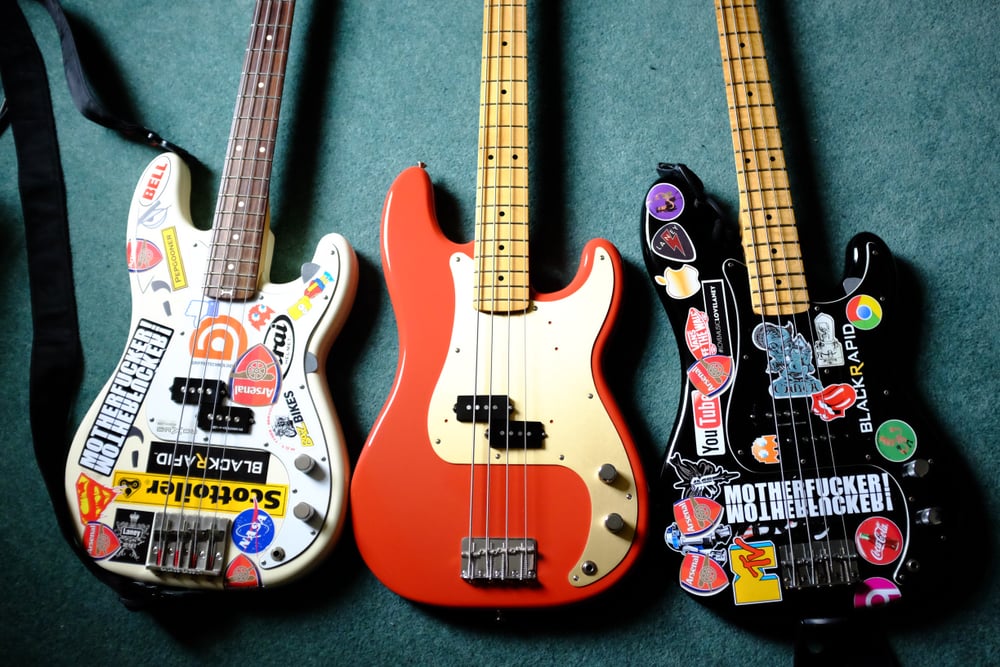
Put on almost any recording from the last 70 years, listen to the bass line, and chances are you are listening to a Fender Precision Bass. That is not an exaggeration. This instrument ended up on so many records that it would be easier to count the ones it is missing from. And the strangest part is that its shape and its sound have barely changed since 1957.
Exactly 75 years have passed since the first one sold in October 1951, and Fender marks the anniversary with a stamp on the back of the headstock of its new models. Matej picked up two Fender Player II Precision Bass guitars for the new episode of Backline, one with a maple and one with a rosewood fingerboard, and tackled a question bass players have been arguing about for decades.
Exactly 75 years have passed since the first one sold in October 1951, and Fender marks the anniversary with a stamp on the back of the headstock of its new models. Matej picked up two Fender Player II Precision Bass guitars for the new episode of Backline, one with a maple and one with a rosewood fingerboard, and tackled a question bass players have been arguing about for decades.
A bass with no competition
To understand why the Precision mattered so much, picture what came before it. The bass player stood behind a double bass, an instrument the size of a grown adult that does not fit in a car and has to be carried up the stairs into the club. Worse still, you could barely hear it. Bands were getting louder, horn sections were going full tilt, guitars had gone electric and drums have always been loud, so the double bass was the first thing to disappear from the mix.
Leo Fender solved it the way he solved everything, which is to say technically. He took the shape he knew from the Telecaster, added a second horn so an instrument with a long, heavy neck would hang level on a strap, and after a lot of experimenting settled on a 34-inch scale. He wanted a string long enough to resonate properly, but not so long that the frets sat uncomfortably far apart. Those 34 inches still hold today and became the standard most bass guitars in the world are built to.
The first one sold in October 1951 for $199.50 and came in a transparent blonde finish only. The trouble started right away, because the guitar amps of the day simply could not handle bass frequencies and fell apart at volume. So Fender had to build the world’s first bass amplifier as well, the legendary Bassman, which went on to become a cult item among guitarists rather than bass players.
Where the name Precision comes from
This is where most people guess wrong, because the word Precision has nothing to do with the sound or with playing accurately. It refers to the frets. A double bass has none, so the player finds the pitch by ear and by feel, and the higher up the neck you go the trickier it gets. Leo Fender was obsessed with manufacturing accuracy, and his instrument had its frets seated so precisely that you could play in tune almost straight away. Hence Precision. It was essentially an advert for the fact that you cannot land on the wrong note, and that is exactly why guitarists who had never held a bass before started switching to it.
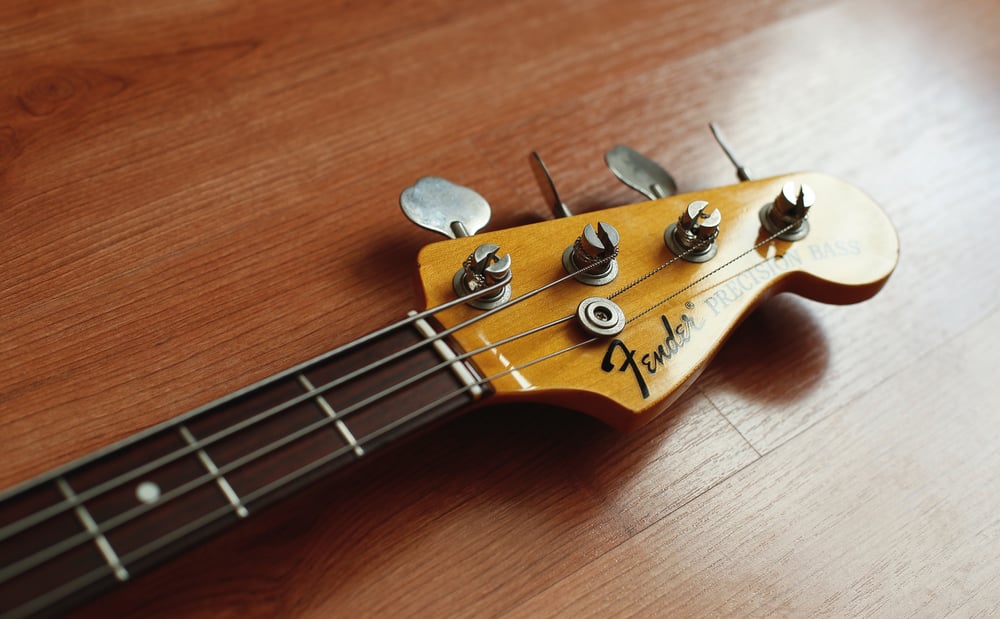
The turning point came in 1957
The Precision spent its first years finding itself. In 1954 it got a contoured body and a forearm cut, because until then it had literally been a slab, and a two-colour sunburst was added. The real turning point, though, came in 1957, when Fender swapped the original simple pickup for a split-coil, a pickup divided into two halves.
There were two practical reasons. The original single-coil pickup hummed, which genuinely annoyed Leo Fender, and its pole pieces sat directly under the strings, producing an attack so hard it tore speakers apart. By splitting the pickup in half, wiring the halves out of phase and moving the magnets to either side of the strings instead of underneath them, he got rid of both the hum and the brutal attack while keeping the sound full and round. That same year the bass got a headstock modelled on the Stratocaster and a pickguard with the electronics mounted straight onto it. It has barely changed since, which is remarkable for an instrument that has been in production since 1951.
Who played one
The person most responsible for making the Precision the standard is probably James Jamerson. He played a 1962 example he called the Funk Machine and recorded virtually the entire golden age of Motown on it. His bass lines are still required listening for anyone serious about the instrument.
On the other side of America, a young Brian Wilson was given a Precision and an amplifier by his father in December 1961 and taught himself to play it in a matter of days. Less than a year later came the debut album by The Beach Boys. The same era gave us Carol Kaye, the session bassist from the Wrecking Crew, who recorded so many sixties hits on a Precision that counting them is a lost cause.
After that it took care of itself. Donald “Duck” Dunn in Booker T. & the M.G.’s, John Entwistle in The Who, Roger Waters in Pink Floyd, Dee Dee Ramone in the Ramones, Paul Simonon in The Clash, Sting in The Police, Bruce Foxton in The Jam. Later Steve Harris in Iron Maiden, Duff McKagan in Guns N’ Roses, Mike Dirnt in Green Day and Nate Mendel in Foo Fighters. It is hard to find a genre the Precision has not played a defining part in, and most of those names now have a signature model of their own. Quincy Jones summed it up by calling the Fender bass “the one technological breakthrough that changed music forever”.

5 things about the Precision you probably did not know
1. The first Precision sold in October 1951 for $199.50 and came in a transparent blonde finish only. Distributors were not remotely enthusiastic at first, so Leo Fender took it around clubs and concert halls himself and won musicians over one at a time.
2. The name has nothing to do with the sound. Precision refers to the precisely seated frets that let you play in tune from day one, unlike the fretless double bass.
3. In 1952, at a Lionel Hampton show, critic Leonard Feather wrote that he could hear a bass but could not see a bass player, and that there were two guitars onstage but only one of them audible. Hampton’s bassist Roy Johnson told him he had no trouble making the switch and had used the instrument on the gig the same day he got it.
4. In 1959, a 14-year-old John Entwistle built his own copy of a Precision from photographs, because you simply could not buy one in Britain at the time. It did not last long. He sold it at the urging of Roger Daltrey, who claimed it kept blowing up their speakers.
5. The bass Paul Simonon is smashing on the cover of London Calling is a Precision. It happened on 20 September 1979 at the Palladium in New York, out of anger at the bouncers who would not let the audience get out of their seats. Photographer Pennie Smith did not want the shot used because she thought it was blurry, and in 2002 Q magazine named it the greatest rock and roll photograph of all time. What is left of that bass is now on display at the Museum of London.
Maple or rosewood?
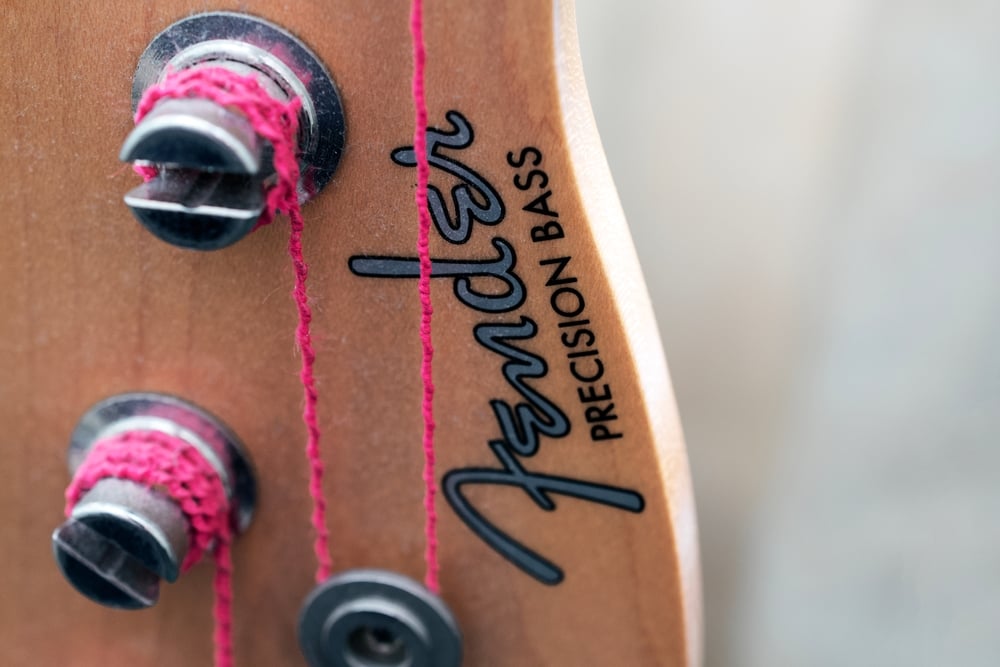
The original Precision had a one-piece maple neck with the fingerboard cut straight into it. In 1959, Fender switched to a glued-on rosewood fingerboard and that became the standard until maple returned as an option in the mid sixties. Since then the choice has been yours.
The difference is real, but smaller than the internet makes out. Maple is a harder, denser wood and it gets lacquered, so the note has a slightly sharper attack and more pronounced top end. It is the sound that works when you need the bass to come across as its own instrument rather than just a bed under the band. Rosewood is left unfinished, is more porous and softer, so it rounds the attack off and sounds a touch warmer and darker overall. You really can hear it, but it is a smaller difference than between two sets of strings and far smaller than what your right hand does to the tone.
What matters far more is how it feels under your fingers. Lacquered maple is smooth and slick, so your hand moves faster across it, but if your palms sweat it can start to grab. Rosewood is matte and rougher, grips the finger slightly better and never gets sticky. Which is exactly why it is worth trying both and going with whatever suits you.
What the Player II series brings
Player II is Fender’s most affordable line, built in Mexico and kept low on price, yet these are still real Fenders with everything that implies. The most visible change from the original Player series is the return of rosewood. Before that the boards were the lighter Pau Ferro, which is perfectly fine in itself, but it never quite looked right, because people automatically associate Fender with rosewood.
The second thing you notice straight away is the rolled fingerboard edges. When you pick a bass up in a shop, the first things that can put you off are fret ends sticking out and a sharp fingerboard edge digging into your palm. Neither is an issue here. The frets are nicely dressed and the board is rounded off top and bottom. The neck is a modern C with a 9.5-inch radius, so it suits a smaller player or a teenager just as well, and the back has a satin polyurethane finish, which in practice means your thumb glides along it and it does not collect grime even when your hands sweat.
The biggest surprise, though, was the pickup. Of all the Fender basses Matej has tested, this one has the cheekiest character. Where the pricier models come across as professional and balanced, this one is honestly cutting and pushes forward, to the point where you can easily picture the bass in a punk band, slicing through everything else. The video has sound samples, so you can judge for yourself. The two instruments are the Player II Precision Bass in Rallye Orange with a maple board and a three-ply white pickguard, and the Cactus Gray version with rosewood.
Which Precision to go for
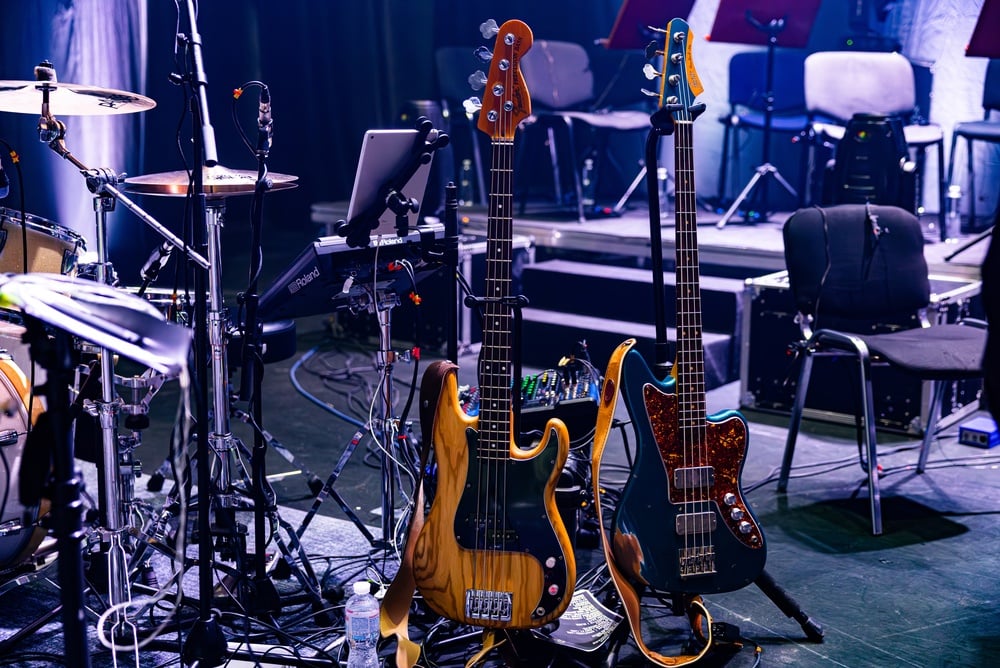
If you want a genuine Fender without spending thousands, Player II is the sensible route. It has nothing to be ashamed of next to pricier models, it has a character of its own, and it suits someone who will only reach for a Fender occasionally but wants the real thing at home. The one slight letdown is that it arrives in a cardboard box with no case included, so budget for a gig bag or a hard case separately.
A step up sit the American Performer and the American Professional II, basses built in the USA with better hardware and pickups. If you want vintage tone and looks, the American Original 60s has them, and if you want exactly the instrument that was sold in the fifties, go for the American Vintage II 1954. It has the original single-coil pickup, the large pre-1957 Telecaster headstock and a 7.25-inch fingerboard radius, considerably rounder than today’s 9.5. If you are after something more modern and lighter, take a look at the Aerodyne Special.
And if you are drawn to one particular player’s sound, the signature models are not just marketing. The Steve Harris Precision has a different pickup and is built for exactly the gallop you know from Iron Maiden, the Duff McKagan Deluxe is voiced for a rougher rock sound, and the Nate Mendel P Bass is a straightforward classic for someone who wants one tone and wants it perfect. The full range is under Fender basses, if you are after your first one look at beginner bass guitars, and if you need a lower range we also have five-string basses. Incidentally, Fender’s other great bass is the Jazz Bass, introduced in 1960, which never replaced the Precision but complemented it.
What else you need
A bass on its own will not get you far, so budget at least for strings, a decent strap and a tuner. If you play at home a small bass combo is enough, but for the rehearsal room and gigs you need something bigger, so have a look at bass combos or go straight for a head and cabinet rig. When you want more than a clean sound out of it, start with a single bass effect, an overdrive or a compressor will do nicely. And if you are still choosing, read How to choose a bass guitar, How to choose a bass amplifier, How to choose a bass cabinet and How to change bass strings. Incidentally, if you enjoy anniversaries like this one, we also have a piece on the Telecaster turning 75.
And if after all of that you still cannot make up your mind, go and try them. Playing a maple and a rosewood board side by side for ten minutes tells you more than any comparison written down. With a bass it is the only thing that really decides anyway, because how it sits in your hand is something no video and no article can tell you. The full range is in electric bass guitars.