 Albania
 Argentina
 Australia
 Austria
 Belgium
 Bosnia and Herzegovina
 Brazil
 Bulgaria
 Canada
 Chile
Chile
 Colombia
 Croatia
 Czech Republic
 Denmark
 Estonia
 Finland
 France
 Germany
 Greece
 Hungary
 Ireland
 Italy
Italy
 Latvia
 Lithuania
 Luxembourg
 Mexico
 Moldova
 Montenegro
 Netherlands
 New Zealand
 North Macedonia
 Norway
 Philippines
 Poland
 Portugal
 Romania
 Serbia
 Slovakia
 Slovenia
 South Africa
 Spain
Spain
 Sweden
 Switzerland
 Turkey
 Ukraine
 United Kingdom
 United States of America







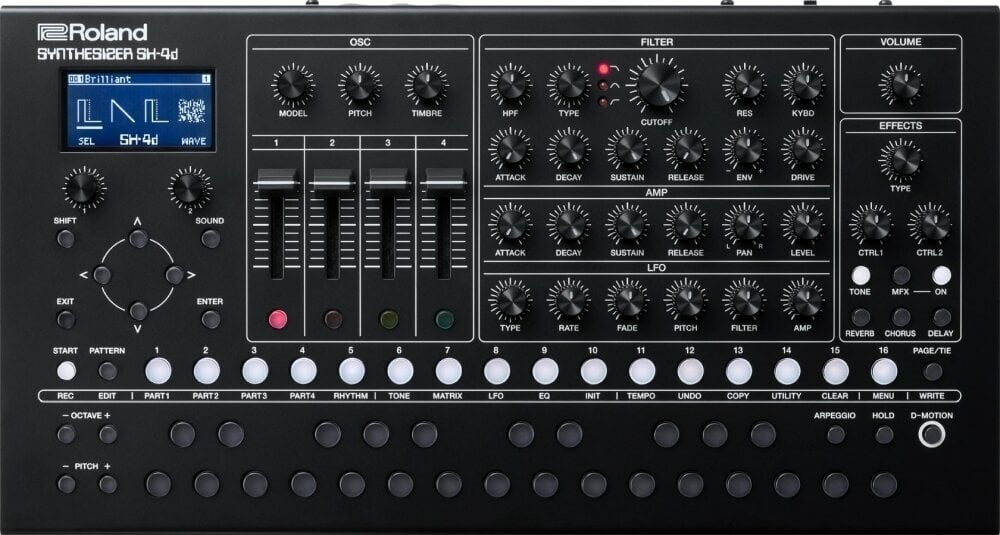
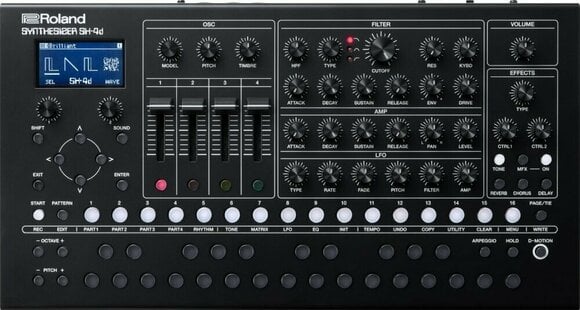
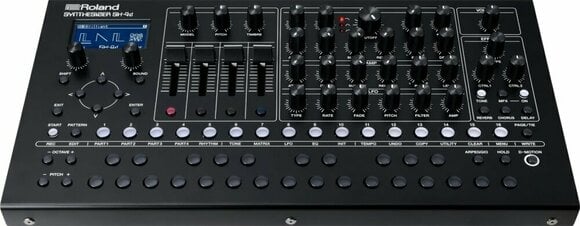
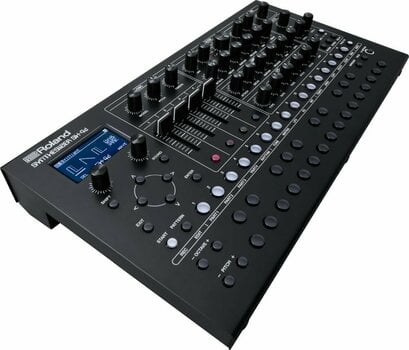

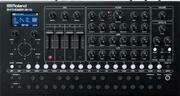
- Тype: Desktop Synthesizer
- Sound Engine: Digital
- Number of Keys: 26
- Polyphony: 60
Roland SH-4D Synthesizer
The Roland SH-4D desktop synthesizer packs a 5-part multitimbral engine, 60-voice polyphony, and 11 OSC models into a portable battery-powered unit. It blends vintage analog-style sound with modern digital textures, including wavetable, cross FM, and the SH-101 and Juno-106 legacy voices. A built-in motion sensor, Visual Arpeggio, and 64-step sequencer make it equally suited for studio sound design and live performance.
- 5-part architecture with 4 synth parts plus a dedicated rhythm part running up to 26 instruments per kit
- 60-voice polyphony with per-part voice reservation for reliable multitimbral playback
- Multimode digital ladder filter with HPF, pre-filter Drive, and interactive Resonance
- Runs on USB-C bus power or 4 AA batteries for up to 4 hours of cable-free creation
Roland SH-4D Desktop Synthesizer — Five Parts, One Portable Groovebox
This desktop synthesizer and groovebox condenses a full multitimbral workstation into a unit small enough to run on AA batteries. Eleven OSC models span vintage analog-style tones, the SH-101 and Juno-106 legacy voices, cross FM, wavetable, ring modulation, sync, chord, drawing, and PCM sounds. With 60 voices of polyphony and a 64-step sequencer per part, this model lets a single hardware unit sketch, sequence, and perform a complete track.
What Sets the Instrument Apart
D-Motion is a built-in motion sensor that lets players tilt the unit to modulate two assignable parameters on the X/Y axis. Visual Arpeggio represents a physics-based mini-sequencer with five modes including bounce, bubble, sketch, pong, and orbit that generates note patterns through interactive on-screen animations. A dedicated Modulation Matrix routes LFOs, envelopes, and external MIDI sources to nearly any parameter, while the multimode digital ladder filter shapes every voice.
Synthesis Architecture — Polyphony and OSC Models
Polyphony and oscillator variety define how complex a track can become inside one box, with enough headroom for layered chords, stacked basslines, and full rhythm parts running simultaneously.
- The device offers 60 voices of maximum polyphony distributed across parts with per-part voice reservation.
- OSC Models: 11 engines — SH-4D, SH-3D, Sync, SH-101, Juno-106, Cross FM, Ring, Wavetable, Chord, Drawing, PCM
- Multitimbral Parts: 5 (4 synth + 1 rhythm) — independent sound design per part
Sequencer, Arpeggiator, and Performance Controls
Pattern sequencing and motion recording turn sound design into full arrangements without leaving the hardware.
- Sequencer Steps: 64 per part — with probability, flams, substeps, and motion recording across four lanes
- Arpeggiator: 5 types — plus the physics-based Visual Arpeggio for motion-driven patterns
- Pitch Bend: Yes — dedicated pitch bend buttons plus D-Motion tilt sensor for X/Y modulation
Effects Engine and Connectivity
A serious effects section and flexible I/O make this unit slot into studio racks, stage rigs, and mobile setups without compromise.
- Effects: Master Effect, Master EQ, Master Compressor, Reverb, Chorus, Delay — plus 93 MFX types across 5 systems
- Modulation: Modulation Matrix — routes LFOs, envelopes, and MIDI CCs to nearly any parameter
- Connectivity: USB-C, 5-pin MIDI I/O, 3.5 mm mix in, 1/4" stereo out, headphone out, clock input — plus 12 discrete USB audio channels to a DAW
Who the SH-4D Is Built For
It is the right choice for electronic producers, groovebox enthusiasts, and live performers who want deep sound design without menu-diving. Synthesists coming from Roland's ZenCore family will appreciate the simplified, hands-on engine layout, while hardware-first beatmakers gain a five-part workstation that runs on AA batteries for sketching on the road. DJs and live acts benefit from D-Motion tilt control and Visual Arpeggio, adding physical performance gestures. Studio producers can route the unit into a DAW over USB-C with 12 discrete audio channels.
Roland and the SH Heritage
Roland's SH series stretches back to the SH-101, a monophonic analog synth from 1982 that became a defining voice in early house, techno, and acid. The Juno-106, released in 1984, brought polyphony and the famous chorus effect to a generation of pop and electronic producers.
",description_sk:
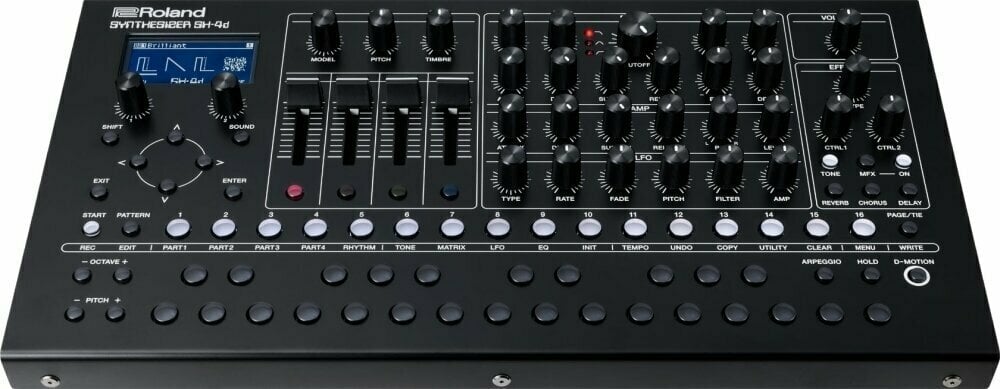
Number of Keys: 26
This instrument has 26 keys, corresponding to 2.5 octaves, offering flexibility and an extended range of tones for various musical applications.
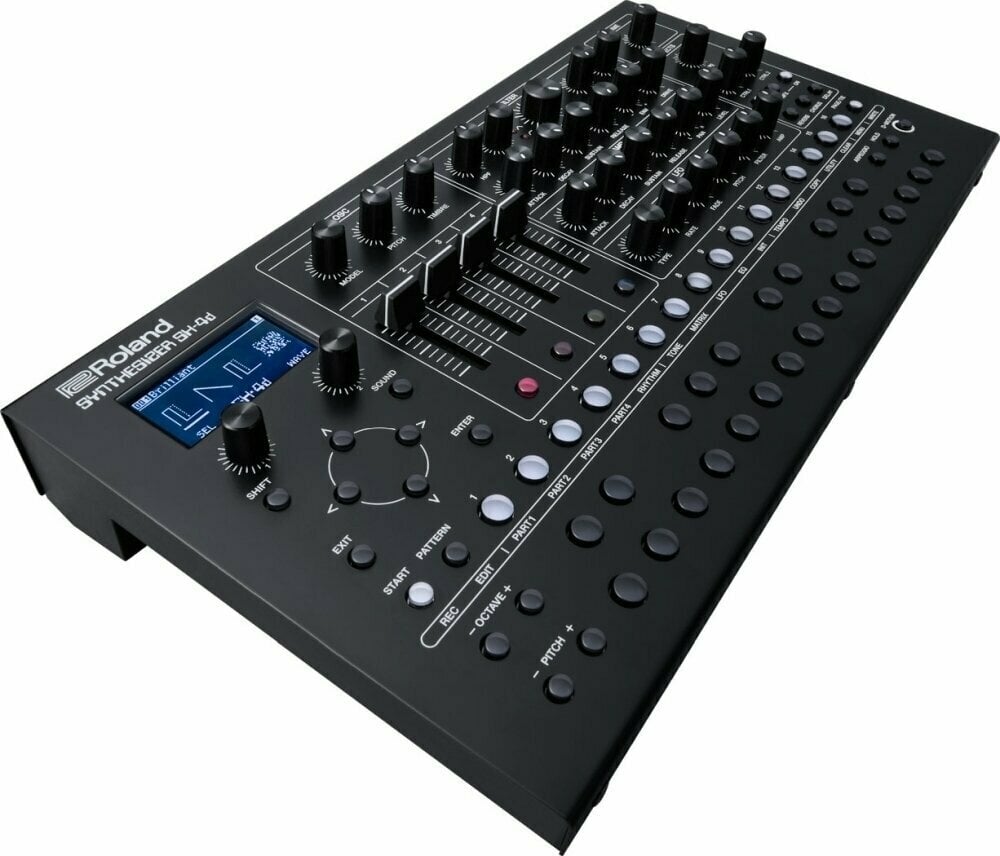
Polyphony: 60
The polyphony of this instrument allows up to <%=tp_value % notes to be played simultaneously, providing rich and complex musical possibilities.

LFO: Yes
An LFO, or low frequency oscillator, brings electronic sound to life. It adds movement and interest to synthetic sounds and effects, playing an important role in both subtle synthesis and bold sound design. However, you won't hear the LFO itself because it acts as a modulator. This means that it does not directly affect the audio signal, but adjusts other parameters such as oscillator pitch and filter clipping.
Envelope: Yes
The Envelope filter gives you precise control over the dynamics and shape of the sound. This filter provides greater flexibility in adjusting and customizing sound characteristics, enhancing the overall quality and expressiveness of the performance.
Oscillators: Yes
A powerful oscillator system allows users to create rich and variable sound textures. Oscillators can generate a variety of waveforms, including sine, square, triangle, and noise, allowing for creativity and experimentation.
Pitch Bend: Yes
The Pitch Bend allows smooth pitch changes, adding expressiveness to musical expression. Often used to create effects such as glissando or vibrato, this feature allows the player to make subtle or dramatic changes to the sound in real time. Pitch bend allows musicians to create smooth transitions between notes, increasing the dynamics and expressiveness of their performances.
Modulation: Yes
Modulation allows you to change different aspects of the sound in real time, opening up a wide range of creative possibilities. For example, it can affect the pitch of the sound, creating a vibrato effect, or it can change the amplitude of the signal, creating a tremolo effect. It can also adjust filtering to create smooth transitions between frequency bands and dynamic textures. Modulation can also be used to change the character of the sound depending on the time or intensity of playing, giving the sound a lively and moving character.
Sequencer: Yes
The sequencer provides musicians with a tool for composing and arranging music, allowing them to create and edit musical sequences. This feature allows you to record and play back repeating patterns. This makes it easy to create complex rhythms and melodies. The sequencer also allows you to layer different musical elements on top of each other, sync with other devices, and adjust parameters in real time. This flexibility makes the sequencer an invaluable tool for producing music, experimenting with new sounds and creating original compositions.
Arpeggiator: Yes
The Arpeggiator transforms chords into sequences of individual notes played in various rhythmic and melodic patterns. Instead of playing the chords as a harmonic whole, the Arpeggiator breaks the chords into individual notes and plays them sequentially according to the selected algorithm.
Effect Types
- Chorus
- Master Effect
- Delay
- Master Compressor
- Master EQ
- Reverb
Headphone Output: Yes
The headphone output allows direct connection of headphones for private listening. This output provides a convenient way to enjoy the sound without disturbing others or ambient noise.
Inputs
- MIDI IN
- Mix IN
- Ext IN
Outputs
- Jack 6,3 mm TS
- Headphone Jack 6,3 mm TRS
- MIDI OUT
MIDI Interface: Yes
It supports MIDI, allowing you to connect and communicate with other MIDI-compatible devices. This feature extends control and integration into the larger music environment, increasing flexibility and creativity in music creation.
Battery Operation: Yes
Battery power provides flexibility and mobility. This feature allows you to use the device anywhere, even in places where an electrical outlet is not available. Battery power is ideal for situations that require portability and independence from the grid, whether you're outdoors, on the road, or in a location with limited access to electricity.
Package Contents
- Manual
- AA Battery
- USB-C - USB-A Cable

Тype
Desktop Synthesizer
LFO
Envelope
Yes
Oscillators
Modulation
Faders
Yes (4)
Arpeggiator
Effect Types
Reverb (9 x), Chorus (5 x), Delay (5 x), Master Effect (93 x), Master EQ, Master Compressor
MIDI Interface
Bluetooth
Built-in Speaker
Arranger
Sound Engine
Number of Keys
Key Size
Mini
Polyphony
Pitch Bend
Yes
Storage Medium
Display
Display Type
Colour
Headphone Output
Pedal Inputs
Analogue Outputs
Microphone Input
USB
USB MIDI
USB to Device
USB to Host
Filter
Yes
Sequencer
Yes
Package Contents
Width (cm)
36
Height (cm)
6.6
Depth (cm)
19.5
Net Weight (kg)
1.78
Made in
Malaysia


Documents
Instructions for use
Safety instructions
Please refer to the user manual for the specific safety instructions for this product.