 Albania
 Argentina
 Australia
 Austria
 Belgium
 Bosnia and Herzegovina
 Brazil
 Bulgaria
 Canada
 Chile
Chile
 Colombia
 Croatia
 Czech Republic
 Denmark
 Estonia
 Finland
 France
 Germany
 Greece
 Hungary
 Ireland
 Italy
Italy
 Latvia
 Lithuania
 Luxembourg
 Mexico
 Moldova
 Montenegro
 Netherlands
 New Zealand
 North Macedonia
 Norway
 Philippines
 Poland
 Portugal
 Romania
 Serbia
 Slovakia
 Slovenia
 South Africa
 Spain
Spain
 Sweden
 Switzerland
 Turkey
 Ukraine
 United Kingdom
 United States of America



Guitar capo: what it does and how to use it
A capo is a small clamp that opens up hundreds of songs without learning new chords. We will show you how a capo works, how to put it on the guitar correctly and which type to choose. And why many guitarists will not leave home without one.

The capo in a nutshell
A capo is a clamp that presses the strings against the fretboard of the guitar and so raises the tuning of the whole instrument. It works like a movable zero fret. Wherever you place the capo, a new „start" of the fretboard appears. That lets you play in a different key while still using the same familiar shapes.
It is one of the cheapest and most useful accessories you can have for the guitar.
What is a capo for?
A capo changes the key of a song without you learning new chords. That is key when you sing. When a song is too high or too low for you, you move the capo and suddenly sing comfortably. It also helps brighten the sound of the guitar and quickly match a second guitarist. Many songs on the radio are recorded with a capo.
How does a capo work and how do you put it on?
Each fret raises the tuning by a semitone. A capo on the second fret therefore raises the pitch by a whole tone, on the fifth by a fourth. The shapes stay the same, only the pitch changes. That is exactly why a few open chords let you play songs in different keys.
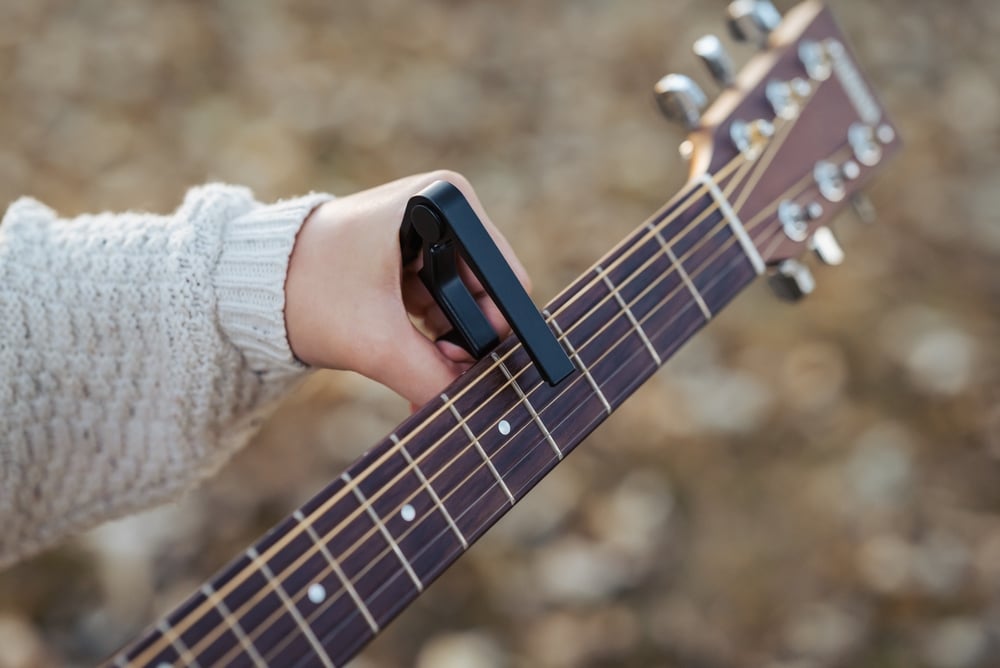
Where exactly do you place the capo?
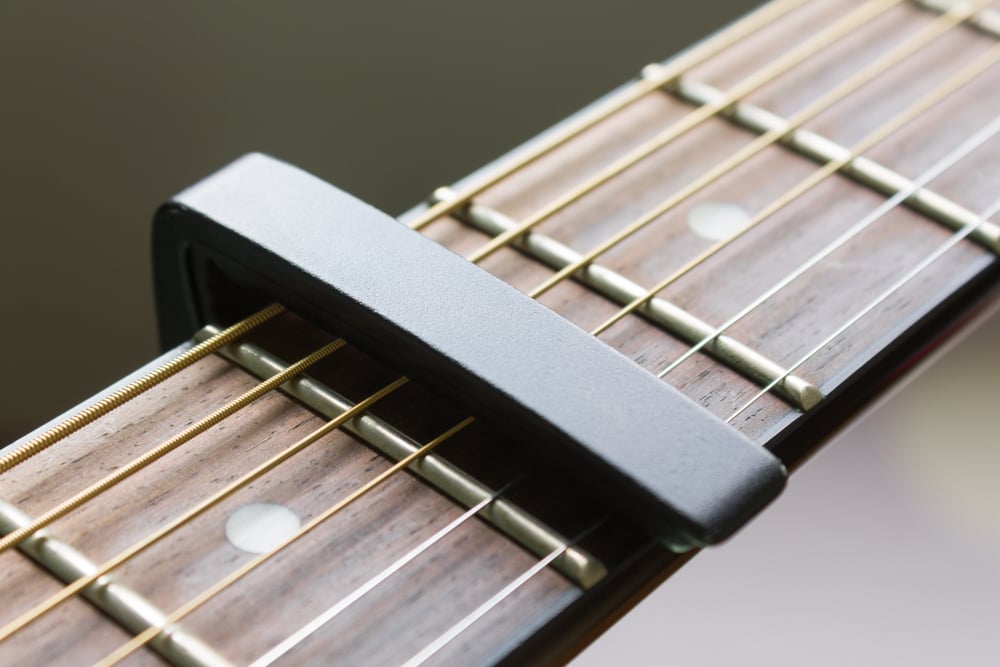
Place the capo just behind the fret, not directly on it and not in the middle between frets. Close to the fret the strings sit nicely and do not buzz. The pressure should be just enough for the notes to ring clean. Too much pressure pulls the strings sharp. After placing it, always strum the strings and tune the guitar if needed. See how in the guide how to tune a guitar.
How to choose a capo?
There are several kinds of capos and they differ in how fast you fit them, in pressure and in price. For most players a trigger or a screw model is the best choice. See the full range in the capos category.
Trigger (spring) capo
The most popular type. You fit it with one hand in a second, ideal for the stage and quick changes while playing. A spring holds it. Brands like Dunlop Trigger or Ernie Ball are among the proven ones. Minor downside: the pressure cannot be fine-tuned, so on cheaper models it sometimes detunes the strings of the guitar.
Screw capo (Shubb and similar)
You set the pressure with a screw, so the strings buzz less and the tuning stays precise. Fitting it takes a moment longer. It is the choice for recording and for players who care about a clean tone. Shubb is a classic in this category.
Elastic and partial capo
The elastic rubber capo is the cheapest and fine to start with, but it does not hold pressure evenly. A partial capo presses only some strings and creates interesting open tunings without retuning. It is more of an experimentation tool for advanced players.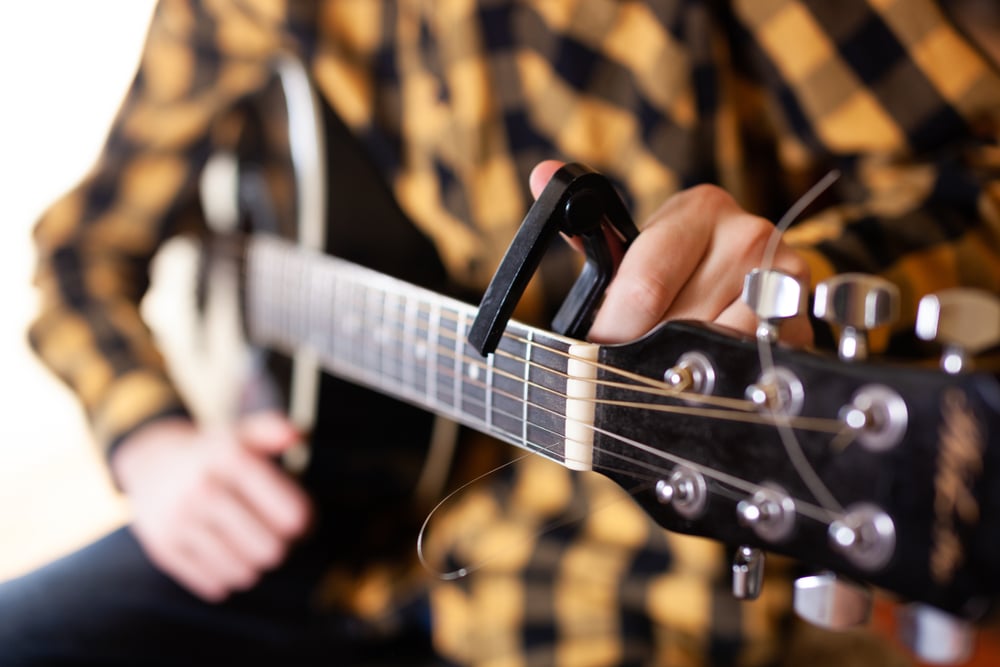
Which capo for which guitar?
The fretboard shape decides. For an acoustic and electric guitar you need a capo with a slightly curved profile, because their fretboard is radiused. For a classical guitar with nylon strings take a flat capo, since its fretboard is flat and wider. A twelve-string guitar needs stronger pressure. There is a small capo for the ukulele too. If you are unsure about choosing the instrument itself, how to choose a guitar will help.
Common mistakes when using a capo
The most common mistake is placing it too far from the fret, which causes buzzing. The second is too much pressure, which pulls the strings sharp and detunes the guitar. The third is leaving the capo clamped in one place for good, which wears the strings faster. After each move of the capo, strum the strings and tune.
Frequently asked questions about the capo
What does a capo look like?
A capo is a small clamp that presses all the strings down at one fret. It looks like a clip or a band across the whole fretboard of the guitar. It raises the tuning and lets you play in a different key with the same shapes.
Does a capo change the guitar's tuning?
Yes, a capo shifts the whole tuning up, by a semitone for each fret. It should not detune the strings against each other. If the guitar sounds off after fitting, ease the pressure or move the capo closer to the fret and tune.
Can you use a capo on a ukulele?
Yes. On the ukulele you use a smaller capo suited to its narrow fretboard. A regular guitar capo is usually too big, so reach for a model made for the ukulele.
Which capo for a classical guitar?
For a classical guitar take a flat capo without a curve. Its fretboard is flat and wider than on an acoustic guitar, so a curved model would not press evenly and the strings would buzz.
By how much does a capo raise the key?
Each fret means a semitone. On the second fret it is a whole tone, on the third one and a half. The shapes do not change, so a C major chord on the second fret actually sounds as D major.
Choose your capo
A capo is a cheap thing with a big effect. It opens up new keys, makes singing easier and speeds up your playing on the guitar. For most players a good trigger or screw model is enough. Have a look at capos, and a tuner and fresh strings go well with it. If you are just starting out, check out how to learn guitar.