 Albania
 Argentina
 Australia
 Austria
 Belgium
 Bosnia and Herzegovina
 Brazil
 Bulgaria
 Canada
 Chile
Chile
 Colombia
 Croatia
 Czech Republic
 Denmark
 Estonia
 Finland
 France
 Germany
 Greece
 Hungary
 Ireland
 Italy
Italy
 Latvia
 Lithuania
 Luxembourg
 Mexico
 Moldova
 Montenegro
 Netherlands
 New Zealand
 North Macedonia
 Norway
 Philippines
 Poland
 Portugal
 Romania
 Serbia
 Slovakia
 Slovenia
 South Africa
 Spain
Spain
 Sweden
 Switzerland
 Turkey
 Ukraine
 United Kingdom
 United States of America







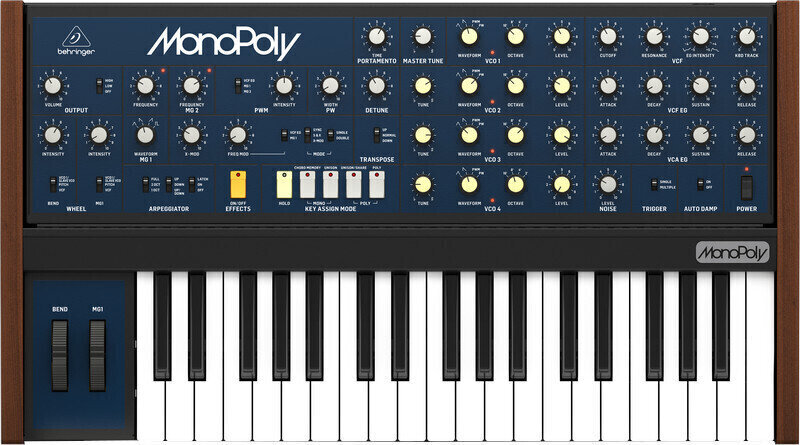
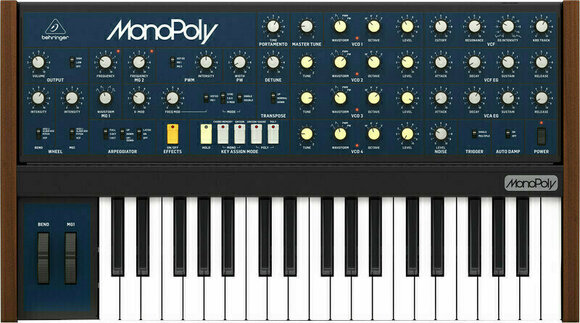
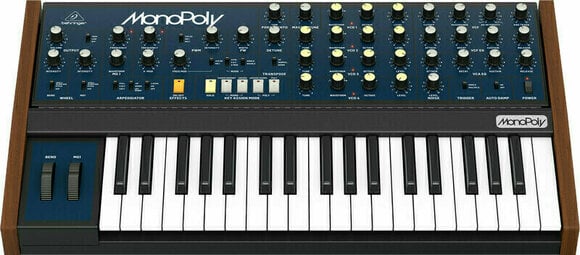
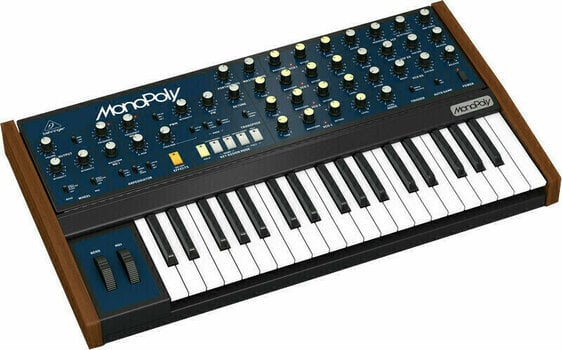
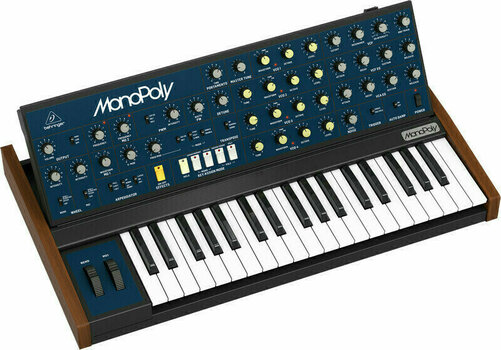
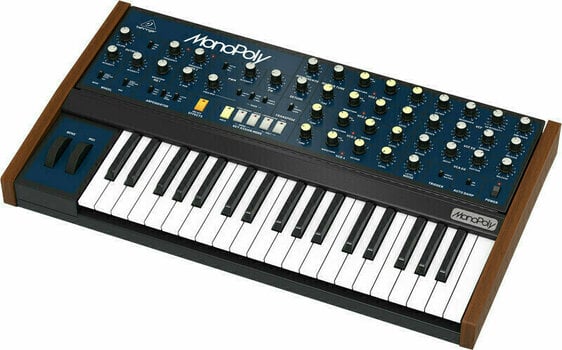

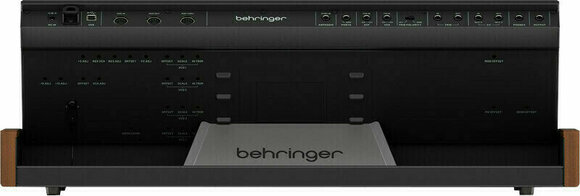
- Тype: Keyboard Synthesizer
- Sound Engine: Analog
- Number of Keys: 37
- Keyboard Type: Velocity sensitive
- Polyphony: 1
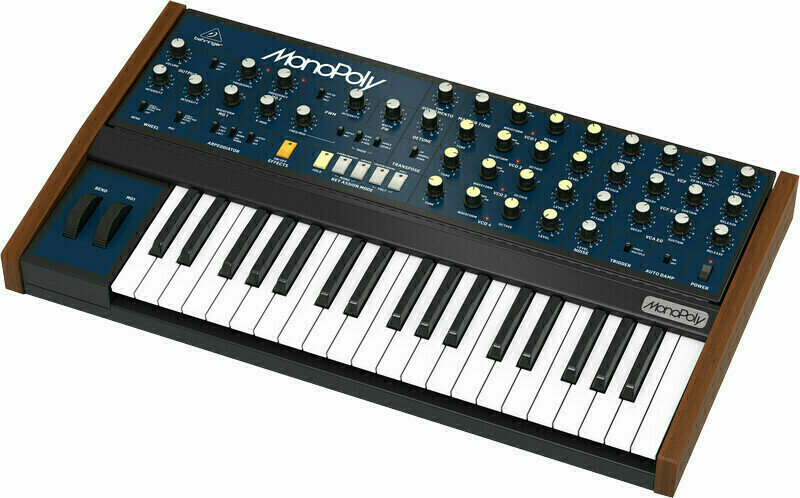
Behringer Monopoly Synthesizer
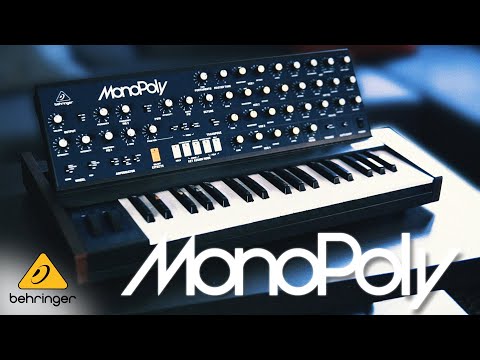
The Behringer MonoPoly is a four-voice analog synthesizer that revives the legendary 1981 Korg Mono/Poly architecture with four independent VCOs, paraphonic voice modes, and a 24 dB SSM2044 low-pass filter. Velocity-sensitive 37 full-size keys, dual ADSR envelopes, two LFOs, and a built-in arpeggiator give players a hands-on path to thick bass, biting leads, and evolving pads. CV/Gate, MIDI In/Out/Thru, and USB-B connectivity slot the unit into hybrid rigs alongside modern gear.
- Four analog VCOs with triangle, sawtooth, and pulse-width waveforms per voice
- Paraphonic Poly mode plus Chord Memory for one-finger harmonies
- SSM2044-based 24 dB low-pass filter with resonance and keyboard tracking
- CV/Gate I/O, MIDI In/Out/Thru, and USB-B for studio and stage integration
Behringer MonoPoly — Four-Voice Analog Synthesizer
The Behringer MonoPoly is a four-voice analog synthesizer that recreates the cult 1981 Korg Mono/Poly architecture at a fraction of the original's price. Four independent VCOs feed a shared SSM2044-based 24 dB low-pass filter, producing fat basses, aggressive sync leads, and dense pads. Velocity-sensitive 37 full-size keys, pitch and mod wheels, and a flip-up angled panel keep programming tactile. This model is the right choice for players who want authentic four-oscillator analog behavior with modern studio connectivity.
Four VCOs, Paraphonic Modes, and SSM Filter Character
What sets this model apart from typical monophonic analogs is its four-oscillator engine and three assign modes: Unison, Poly, and Unison Share. Oscillator sync and cross-modulation open a wide range from subtle FM timbres to screaming sync leads. The SSM2044 low-pass filter — heard in the Korg Polysix and PPG Wave 2.2 — delivers the warm, fat low end that defines this synth's voice.
Sound Generation — Four Analog VCOs and Noise
Each VCO offers triangle, sawtooth, and pulse waveforms with PWM, an octave selector covering 16", 8", 4", and 2", plus fine tuning and per-oscillator volume. A dedicated noise generator mixes in independently for breath, percussion, or air.
- Oscillators: 4 analog VCOs — independent waveforms, octaves, and tuning per voice
- Waveforms per VCO: triangle, sawtooth, pulse, PWM — covers classic subtractive and FM territory
- Built-in noise generator for breath, percussion, and air
Filter and Envelopes — SSM2044 with Dual ADSR
The shared 24 dB low-pass filter offers adjustable resonance plus keyboard tracking. Two ADSR envelopes — one for VCF and one for VCA — shape filter sweep and amplitude contour independently. Trigger modes (Single/Multiple) and Auto Damp determine how envelopes re-trigger when new notes arrive.
- Filter: 24 dB/octave low-pass (SSM2044) — fat, resonant character with keyboard tracking
- Envelopes: 2 ADSR (VCF + VCA) — independent filter and amplitude shaping per note
- Paraphonic architecture — up to 4 notes share a single filter and VCA
Modulation, Arpeggiator, and I/O
Two LFOs (MG1 with four waveforms, MG2 triangle-only) drive PWM, filter cutoff, and pitch vibrato. The arpeggiator offers up/down patterns with octave range and latch mode, syncable via 6.3 mm jack. CV/Gate I/O, MIDI In/Out/Thru, USB-B, and a portamento foot-switch input round out the connectivity.
- LFOs: 2 (MG1: 4 waveforms, MG2: triangle) — modulate PWM, cutoff, and pitch
- Arpeggiator: up/down/up/down with octave range and latch — pattern-based sequencing on tap
- CV/Gate I/O, MIDI In/Out/Thru, USB-B, and a portamento foot-switch input for hybrid analog/digital rigs
Who Is the Behringer MonoPoly For
The synthesizer is the right choice for synthwave producers, electronic musicians, and sound designers who want four-oscillator analog character at an accessible price. Players coming from softsynths will appreciate the hands-on programming surface with 41 dedicated knobs and a flip-up panel. Live performers benefit from the 37-key velocity-sensitive action and the arpeggiator's latch mode for hands-free sequences. From thick Italo-disco basslines to aggressive sync leads, this instrument delivers vintage architecture without the vintage price tag.
Behringer — Affordable Studio Tools Since 1989
Founded in Germany by Uli Behringer, the company has built its reputation on capable music-making tools at accessible prices, beginning with the Studio Exciter F. The portfolio expanded through mixing consoles like the Eurodesk MX8000 and grew further with the acquisition of Midas, Klark Teknik, and TC Electronic. The MonoPoly continues that mission by reintroducing a sought-after 1980s four-oscillator design.
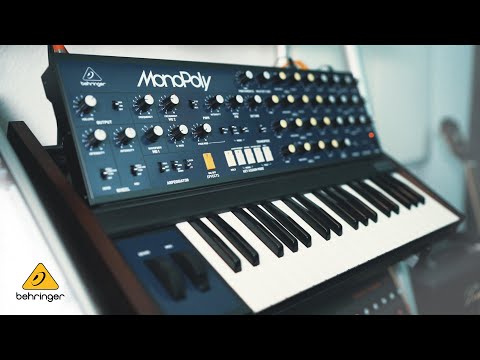
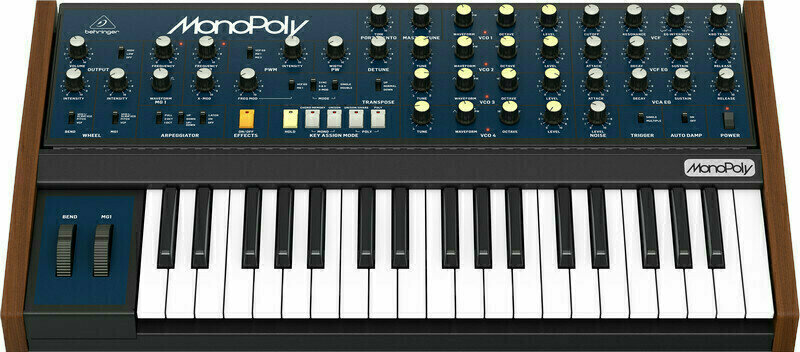
Number of Keys: 37
This instrument has 37 keys, equivalent to 3 octaves, providing a wide range of tones for a variety of musical applications.
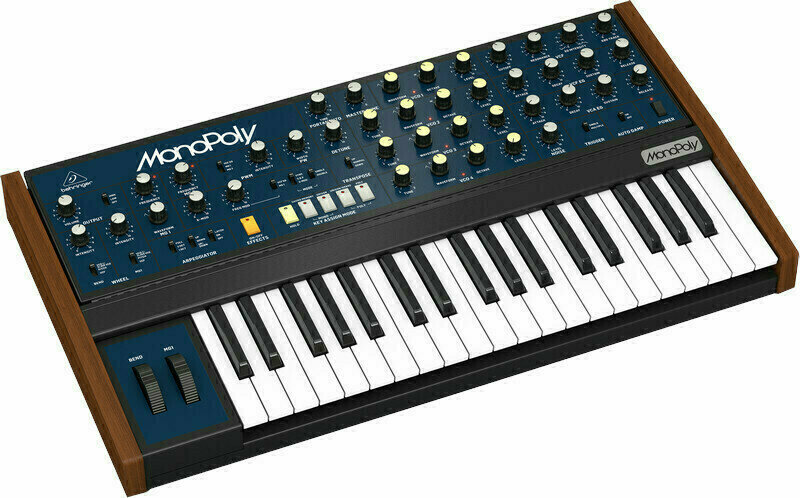
Polyphony: 1
This instrument is monophonic, meaning it plays only one note, which cannot be combined simultaneously with another.
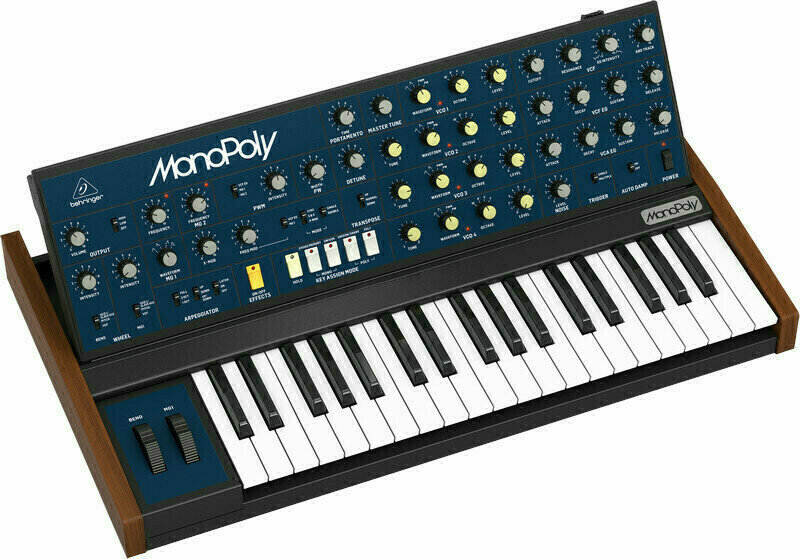
LFO: 2
An LFO, or low frequency oscillator, brings electronic sound to life. It adds movement and interest to synthetic sounds and effects, playing an important role in both subtle synthesis and bold sound design. However, you won't hear the LFO itself because it acts as a modulator. This means that it does not directly affect the audio signal, but adjusts other parameters such as oscillator pitch and filter clipping.
Envelope: ADSR
The ADSR (Attack, Decay, Sustain, Release) type envelope filter gives you precise control over the dynamics and shape of your sound. The ADSR components are detailed as follows: Attack: Specifies how quickly the sound reaches its maximum volume upon activation. Decay: Specifies the time it takes for the volume to drop from maximum to sustain. Sustain: Represents a stable volume level that is maintained as long as the sound is active. Release: Specifies how quickly the volume fades to zero after the sound has been released.
Oscillators
- Analog VCO
- 4
Pitch Bend: Yes
The Pitch Bend allows smooth pitch changes, adding expressiveness to musical expression. Often used to create effects such as glissando or vibrato, this feature allows the player to make subtle or dramatic changes to the sound in real time. Pitch bend allows musicians to create smooth transitions between notes, increasing the dynamics and expressiveness of their performances.
Modulation: Yes
Modulation allows you to change different aspects of the sound in real time, opening up a wide range of creative possibilities. For example, it can affect the pitch of the sound, creating a vibrato effect, or it can change the amplitude of the signal, creating a tremolo effect. It can also adjust filtering to create smooth transitions between frequency bands and dynamic textures. Modulation can also be used to change the character of the sound depending on the time or intensity of playing, giving the sound a lively and moving character.
Arpeggiator: Yes
The Arpeggiator transforms chords into sequences of individual notes played in various rhythmic and melodic patterns. Instead of playing the chords as a harmonic whole, the Arpeggiator breaks the chords into individual notes and plays them sequentially according to the selected algorithm.
Headphone Output: Yes
The headphone output allows direct connection of headphones for private listening. This output provides a convenient way to enjoy the sound without disturbing others or ambient noise.
Inputs
- Jack 3,5 mm TRS
- MIDI IN
- CV (patchpoints)
- Triger
- Jack 3,5 mm TS
Outputs
- Jack 6,3 mm TS
- Jack 6,3 mm TRS
- MIDI Thru
- MIDI OUT
Pedal Inputs: Yes
The pedal input allows you to connect an external pedal that expands the instrument's control capabilities and contributes to a richer musical expression, increasing flexibility and expressiveness when playing and creating music.
MIDI Interface: Yes
It supports MIDI, allowing you to connect and communicate with other MIDI-compatible devices. This feature extends control and integration into the larger music environment, increasing flexibility and creativity in music creation.
Package Contents
- Adapter
- Manual

Тype
Keyboard Synthesizer
Aftertouch
LFO
Envelope
ADSR (2 )
Oscillators
Modulation
Arpeggiator
MIDI Interface
Touch Sensitive
Sound Engine
Number of Keys
Keyboard Type
Velocity sensitive
Key Size
Standard
Polyphony
Pitch Bend
Yes
Storage Medium
Colour
Headphone Output
Outputs
Pedal Inputs
Analogue Outputs
USB MIDI
USB to Host
Filter
Low Pass
Power Supply
12V, Adapter
UK/EU Power supply included
Width (cm)
64.8
Height (cm)
9
Depth (cm)
36.1
Net Weight (kg)
10.3
Made in
China


Documents
Instructions for use
Manufacturer information
Safety instructions
Please refer to the user manual for the specific safety instructions for this product.


