 Albania
 Argentina
 Australia
 Austria
 Belgium
 Bosnia and Herzegovina
 Brazil
 Bulgaria
 Canada
 Chile
Chile
 Colombia
 Croatia
 Czech Republic
 Denmark
 Estonia
 Finland
 France
 Germany
 Greece
 Hungary
 Ireland
 Italy
Italy
 Latvia
 Lithuania
 Luxembourg
 Mexico
 Moldova
 Montenegro
 Netherlands
 New Zealand
 North Macedonia
 Norway
 Philippines
 Poland
 Portugal
 Romania
 Serbia
 Slovakia
 Slovenia
 South Africa
 Spain
Spain
 Sweden
 Switzerland
 Turkey
 Ukraine
 United Kingdom
 United States of America








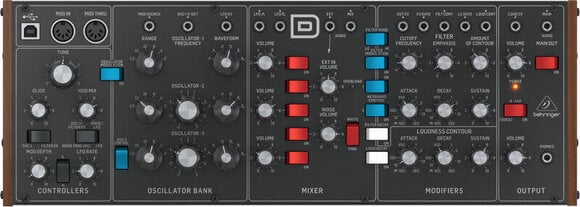
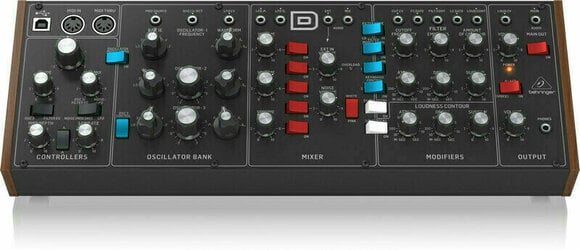
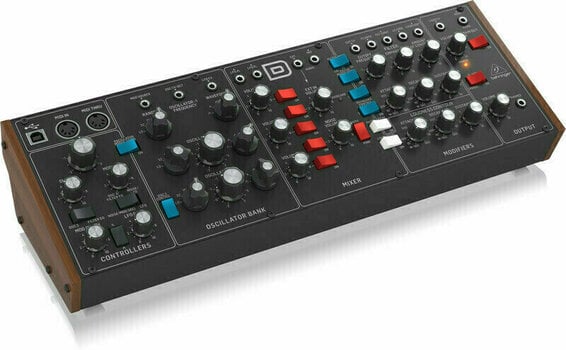
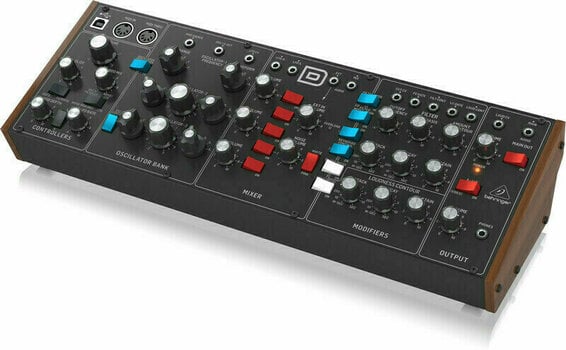
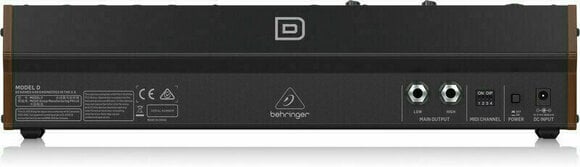

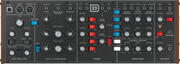
Behringer Model D Synthesizer
The Behringer Model D is an authentic analog monophonic synthesizer that recreates the legendary Minimoog Model D at a fraction of the original's cost. Three voltage-controlled oscillators feed a 24 dB ladder filter with selectable low- and high-pass modes, while a semi-modular patch bay and Eurorack-ready chassis make it equally at home on a desktop or in a modular rig.
- Three analog VCOs with six waveforms each and a six-octave range give the Model D its unmistakable fat, punchy character.
- The 24 dB ladder filter self-oscillates and offers both low-pass and high-pass modes, expanding the classic Moog voicing with extra timbral options.
- Semi-modular design with 3.5 mm patch jacks means it works straight out of the box yet interfaces cleanly with any Eurorack system.
- Chain up to 16 units for polyphonic performance, and connect via USB MIDI or traditional DIN for full studio integration.
Behringer Model D Analog Synthesizer — Classic Moog Voice, Modern Price
The Behringer Model D is an authentic analog monophonic synthesizer designed as an ultra-affordable homage to the iconic 1970s Minimoog Model D. Its pure analog signal path is built around three voltage-controlled oscillators, a 24 dB ladder filter, a dedicated VCA, and a fully analog triangle/square wave LFO. The Model D is the right choice for producers, sound designers, and performing keyboardists who want the unmistakable fat bass and lead tones of a vintage Moog without paying vintage prices.
What Sets the Model D Apart in the Analog Synth Category
Few modern analog synths at this price point offer a true Eurorack-compatible chassis, and the Model D ships in a 70HP "boat" case that drops straight into a standard rack. The 24 dB ladder filter is dual-mode, providing both the expected low-pass response and a high-pass mode that the original Minimoog never had, opening up new timbral territory. A built-in feedback loop routes the main output back into the external audio input when nothing is patched in, letting players dial in everything from subtle thickening to aggressive saturation without extra cables.
Oscillator Architecture — The Heart of the Sound
The three-oscillator architecture is what gives the Model D its famously thick, punchy character. Oscillators 1 and 2 each offer six waveforms (triangle, triangle/saw, saw, square, wide pulse, narrow pulse), while OSC 3 swaps the triangle/saw for a reverse saw, making it equally useful as an audio source or as a sub-audio modulation source.
- Oscillators: 3 analog VCOs — the foundation of the classic Moog stack sound
- Waveforms per OSC: 6 selectable shapes — broad timbral range from soft triangles to aggressive pulse waves
- Octave Range: LO, 32', 16', 8', 4', 2' — six octaves of coverage from sub-bass to high leads
- Detune Range: approx. ±7 semitones (OSC 2 and OSC 3) — for everything from gentle chorus to dissonant intervals
Filter, Envelopes, and Modulation — Shaping Every Note
The 24 dB ladder filter is the soul of the instrument, capable of self-oscillation down to 64 Hz and offering switchable low-pass and high-pass modes. Independent ADS(D) envelope generators shape both the filter cutoff and the VCA, with the loudness contour offering a maximum attack of around 11 seconds and a release of roughly 22 seconds. Five modulation sources — OSC 3, filter envelope, noise, external input, and the dedicated LFO — can be mixed and routed to either oscillator pitch or filter cutoff.
- Filter: 24 dB/oct ladder, switchable LP/HP — self-oscillating resonance with classic Moog character
- Envelopes: 2× ADS(D) (filter + loudness) — independent gate inputs for advanced patching
- LFO: 1 analog triangle/square wave — switchable rate, depth, and modulation routing
- Noise Generator: switchable pink/white — adds air, grit, or percussion-style sounds
Connectivity, Build, and Poly Chain — Studio and Stage Ready
The Model D weighs less than 2 kg and packs 29 knobs and 19 switches into a compact 374 × 136 mm panel. MIDI I/O and Thru are available over both USB and traditional DIN, and a dedicated headphone output with its own volume control sits on the front panel. The semi-modular patch bay exposes 3.5 mm jacks for pitch CV, LFO frequency, filter cutoff, amplifier gain, envelope gates, and external modulation, while the Poly Chain function links up to 16 units for full polyphonic performance.
- Poly Chain: up to 16 voices — combine multiple units for true polyphony
- MIDI: USB + DIN In/Out/Thru — works with any modern DAW or hardware controller
- Patch Bay: 3.5 mm semi-modular jacks — interfaces with Eurorack and external CV gear
- Headphone Output: yes, with dedicated volume — silent practice without an audio interface
- Power: external 12V DC — keeps the analog circuitry isolated from digital noise
Who the Behringer Model D Is For
The Behringer Model D is the right choice for electronic musicians, hip-hop and synthwave producers, and live performers who need authoritative analog bass and lead tones at a price that fits any project studio. Sound designers will appreciate the semi-modular patch bay and Eurorack compatibility for integrating the synth into a larger modular system. Beginners stepping into analog synthesis for the first time will find the intuitively linear workflow approachable, with no patching required for immediate play. Players who already own a Minimoog Model D or a Moog reissue can use the Model D as a portable, road-ready backup that captures the same sonic DNA.
Behringer and the Model D Story
Behringer was founded by Uli Behringer, who grew up in a musical family in Baden, Switzerland and built his first synthesizer at the age of 17. The Model D pays tribute to the Minimoog Model D that defined progressive rock, wave, and synth-pop in the 1970s and '80s, an instrument championed by Jan Hammer, Chick Corea, Rick Wakeman, Jean-Michel Jarre, Isao Tomita, and Keith Emerson. By recreating that legendary architecture with matched transistors, JFETs, and 0.1% thin-film resistors, Behringer has made one of synthesis history's most coveted voices accessible to a new generation of players.
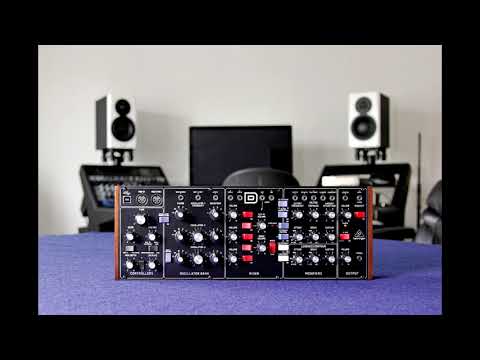
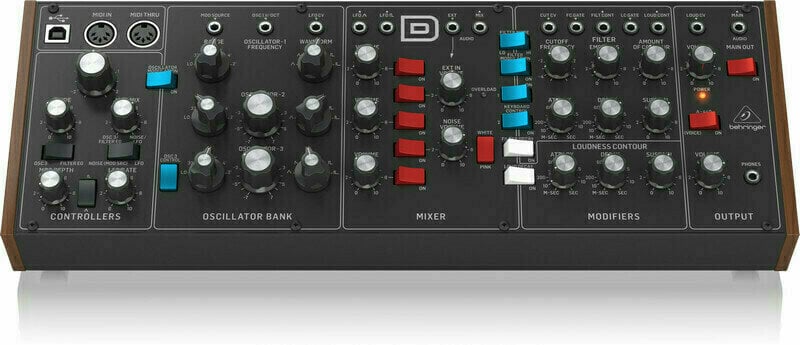
LFO: 1
An LFO, or low frequency oscillator, brings electronic sound to life. It adds movement and interest to synthetic sounds and effects, playing an important role in both subtle synthesis and bold sound design. However, you won't hear the LFO itself because it acts as a modulator. This means that it does not directly affect the audio signal, but adjusts other parameters such as oscillator pitch and filter clipping.
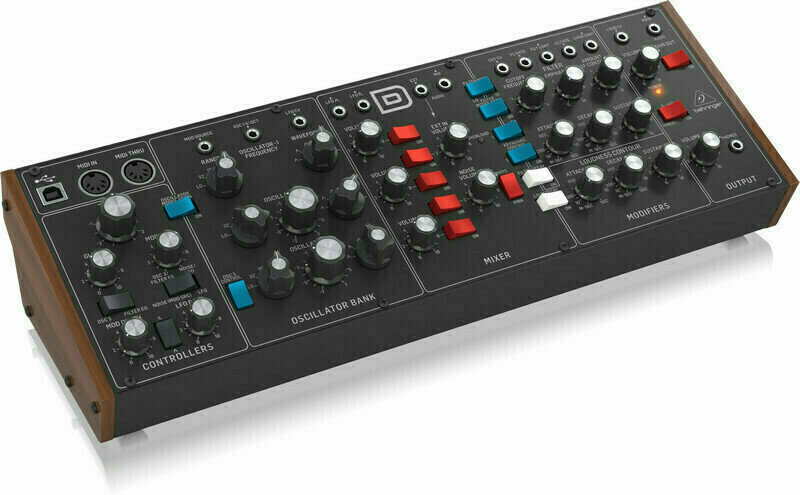
Envelope: Yes
The Envelope filter gives you precise control over the dynamics and shape of the sound. This filter provides greater flexibility in adjusting and customizing sound characteristics, enhancing the overall quality and expressiveness of the performance.
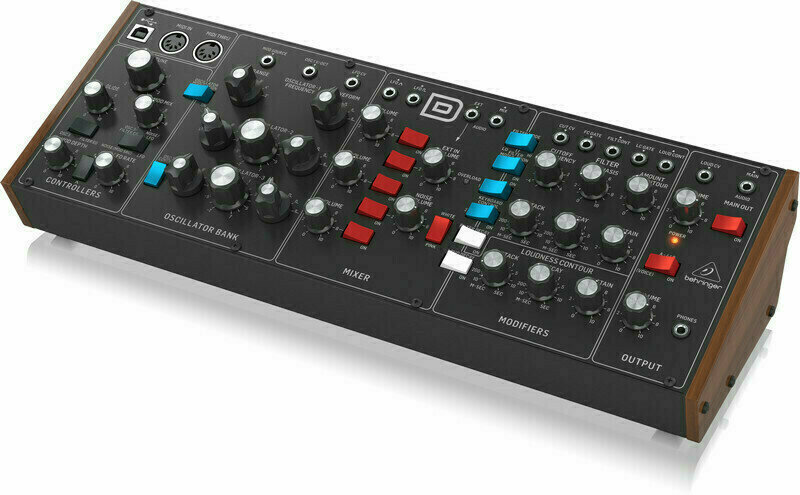
Oscillators: 3
This three-oscillator synthesizer offers a wide range of sonic possibilities and creative expression. With three oscillators, users can experiment with harmonic interactions, adjust the frequencies and amplitudes of individual oscillators, and create composite sounds that combine different textures and colors.

Headphone Output: Yes
The headphone output allows direct connection of headphones for private listening. This output provides a convenient way to enjoy the sound without disturbing others or ambient noise.
Inputs
- CV (patchpoints)
- Jack 3,5 mm TRS
- Line Jack 6,3 mm
MIDI Interface: Yes
It supports MIDI, allowing you to connect and communicate with other MIDI-compatible devices. This feature extends control and integration into the larger music environment, increasing flexibility and creativity in music creation.
Package Contents
- Adapter
- Manual

Тype
Desktop Synthesizer, Semi-modular
Aftertouch
LFO
Envelope
Yes
Oscillators
Modulation
Arpeggiator
Effect Types
MIDI Interface
Bluetooth
Headphone Output
Outputs
Pedal Inputs
USB MIDI
USB to Host
Filter
Low Pass, High Pass
Sequencer
No
Power Supply
Adapter
UK/EU Power supply included
Width (cm)
37.4
Height (cm)
9
Depth (cm)
13.6
Net Weight (kg)
1.7
Made in
China


All reviews come from verified customers who have purchased a product from us in the past.
AI summary of reviews
Based on the number of reviews: 25
Strengths
- Sound Quality: Customers consistently highlight the outstanding sound, especially the powerful bass, noting how well it sits in a mix.
- Value for Money: Many users are impressed by the quality offered at its price point, considering it an excellent investment.
- Ease of Use: The synthesizer is appreciated for its hands-on controls, which eliminate the need for menu diving and provide a retro feel.
- Compact Design: Its small footprint is a significant advantage, making it a space-saving option for users.
Weaknesses
- Beginner Learning Curve: Some new users might find the initial learning process challenging, though it becomes enjoyable with practice.
What customers repeat
Verdict
Documents
Instructions for use
Manufacturer information
Safety instructions
Please refer to the user manual for the specific safety instructions for this product.


