 Albania
 Argentina
 Australia
 Austria
 Belgium
 Bosnia and Herzegovina
 Brazil
 Bulgaria
 Canada
 Chile
Chile
 Colombia
 Croatia
 Czech Republic
 Denmark
 Estonia
 Finland
 France
 Germany
 Greece
 Hungary
 Ireland
 Italy
Italy
 Latvia
 Lithuania
 Luxembourg
 Mexico
 Moldova
 Montenegro
 Netherlands
 New Zealand
 North Macedonia
 Norway
 Philippines
 Poland
 Portugal
 Romania
 Serbia
 Slovakia
 Slovenia
 South Africa
 Spain
Spain
 Sweden
 Switzerland
 Turkey
 Ukraine
 United Kingdom
 United States of America



Parts of a guitar: a beginner's guide
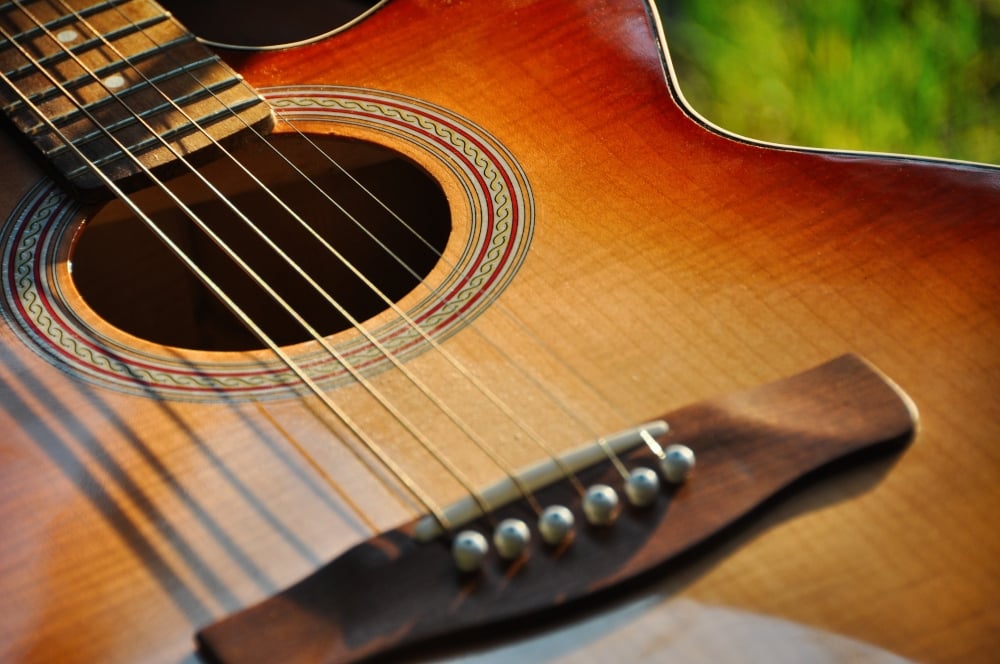
Headstock and tuning machines
At the very top of the guitar sits the headstock, and mounted on it are the tuning machines. Turning them tightens or loosens the strings and changes their pitch.
A machine head might look like just a machine head, but quality varies. Better sealed-case tuners (from brands like Grover or Gotoh) hold tuning far longer than the cheap open tuners on a 30 € guitar. If your guitar will not stay in tune, the tuners are often the culprit. They can be replaced, see guitar tuning machines. And if tuning itself is the problem, a decent tuner will help.
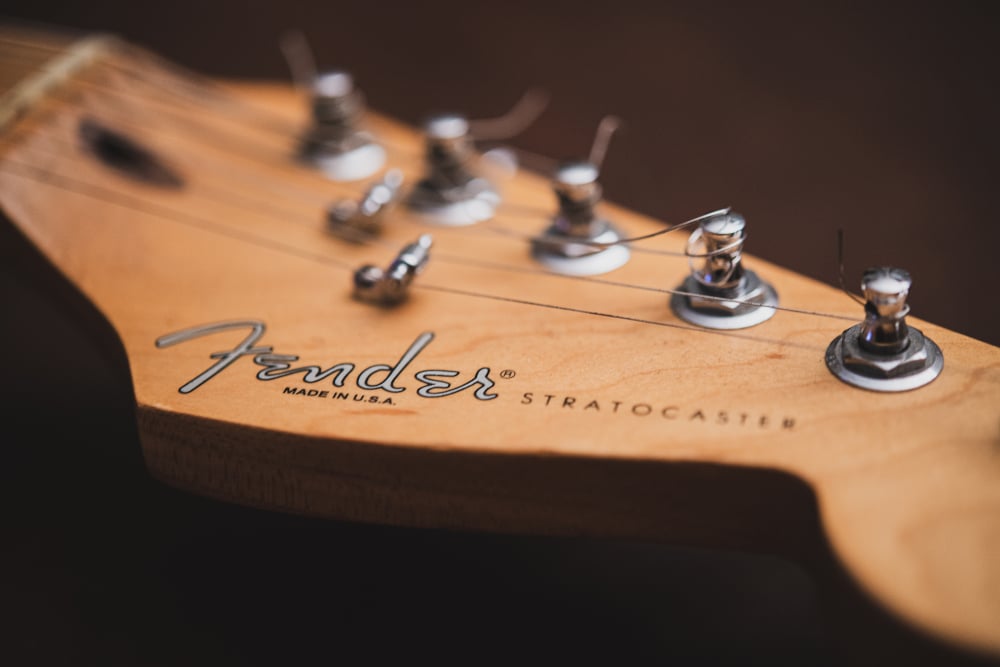
What the nut does
The nut is the small slotted strip at the bottom of the headstock, where the neck meets the head. The strings pass over it, and the nut sets both their spacing and their height above the fretboard.
Why does it matter? If the nut is cut too high, the first frets are harder to press down. A beginner's fingers hurt and playing turns frustrating. The material, whether plastic, bone, ebony or synthetic bone such as TUSQ, also affects tone transfer and tuning stability.
Neck, fretboard and frets
The neck is the long shaft running from the body to the headstock. The fretboard is the top plate glued onto the neck, the surface you press your fingers against. Set into it are the metal strips called frets.
The fretboard material affects both feel and sound. Rosewood reads as warmer, maple as brighter and sharper. For a beginner it makes little difference, comfort matters far more.
Watch out for one common mix-up. When someone says a guitar has "a rosewood neck", they mean the fretboard. The neck itself is usually mahogany or maple, the fretboard is only that thin top layer.
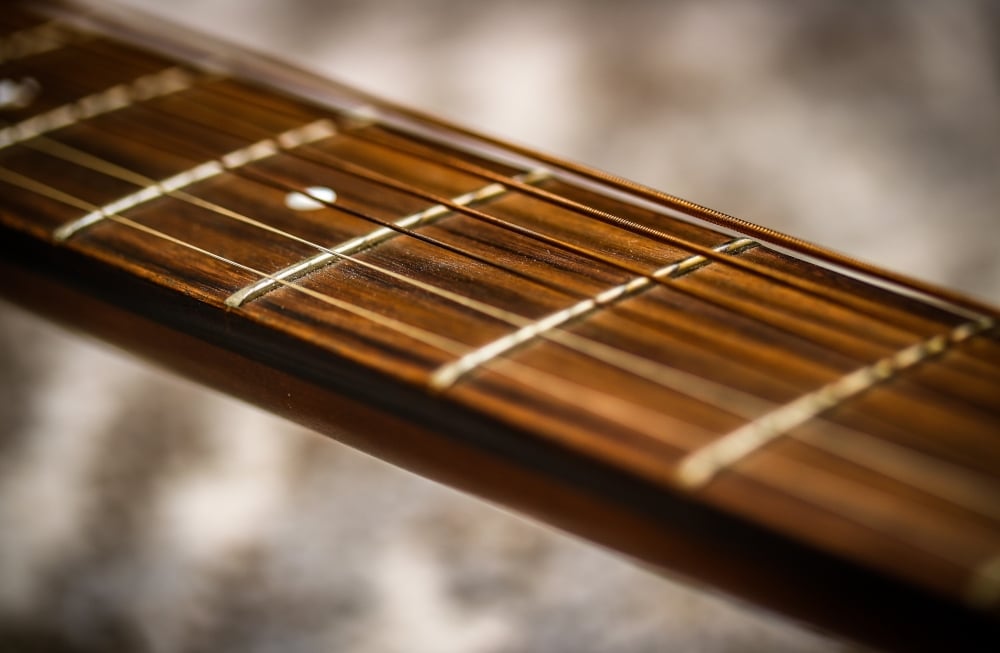
Fret numbering and positions on the fretboard
Frets are numbered from the nut towards the body. The first fret is the one closest to the headstock. When a tutorial says "play the note on the 3rd fret", you press into the space between the second and third metal strip, not onto the strip itself.
The higher the fret, the higher the note. The twelfth fret sits roughly halfway along the scale length and sounds exactly one octave above the open string. Most acoustics have 20 to 21 frets, electrics usually 21 to 24.
If notes go sour higher up the neck, worn strings can be the cause. They are a consumable and need replacing.
A capo works as a movable nut. It clamps the strings just behind a chosen fret and shifts the whole tuning up, so the same shapes sound in a different key.
Body and bridge
The body is the largest part of the guitar. On an acoustic it is hollow and works as a resonating chamber that naturally amplifies the strings. On an electric it is usually solid wood, because the amp does the amplifying.
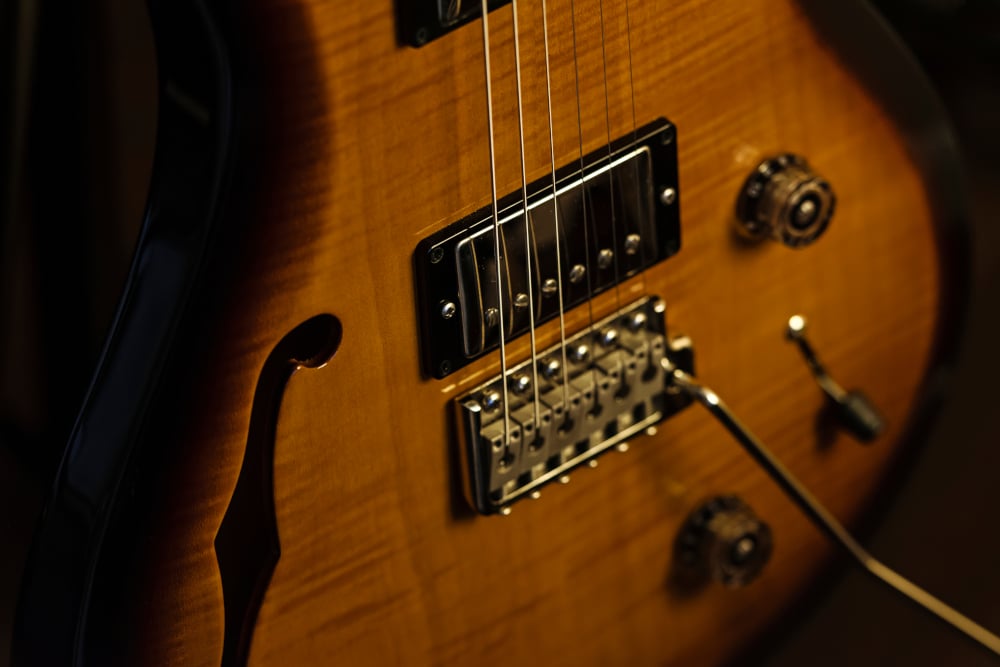
The bridge is the metal or plastic part on the body where the strings anchor at the bottom end. There are three basic types:
- A hardtail bridge is simple, reliable and holds tuning well. Ideal for beginners.
- A vibrato or tremolo adds an arm that bends the pitch while you play. It takes some getting used to on the tuning front.
- A locking bridge (Floyd Rose) handles extreme arm work. The design is more complex and suits advanced players.
For a first guitar we recommend a hardtail, less fuss with tuning and setup. Browse the full range of guitar bridges.
Pickups on an electric guitar
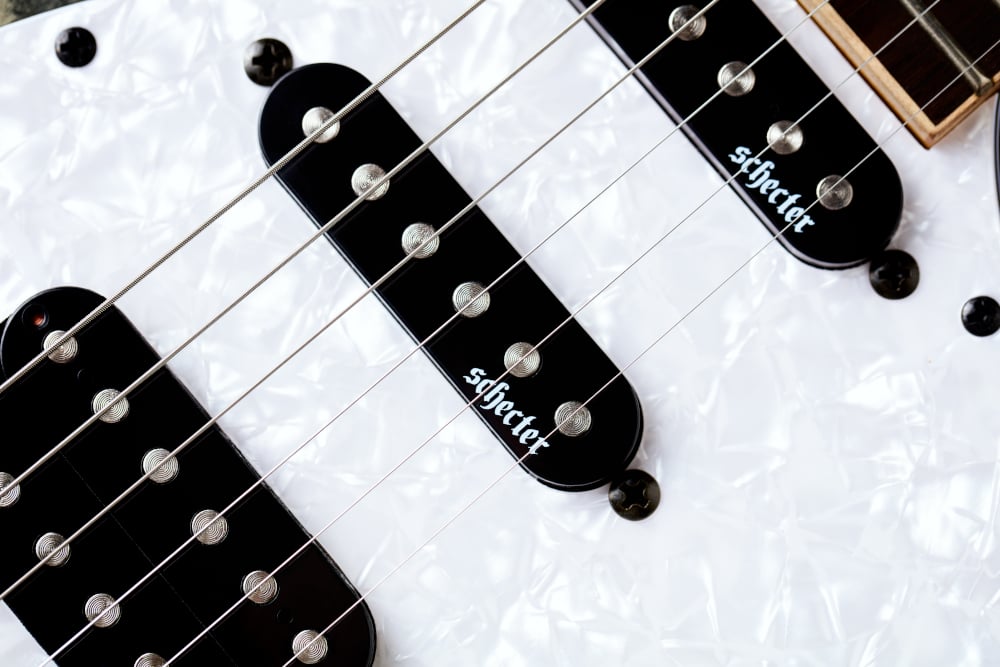
Pickups are electromagnetic coils mounted under the strings of an electric guitar. They capture the movement of the metal strings and turn it into an electrical signal that goes to the amp.
There are two main types:
- A single-coil (Fender Stratocaster or Telecaster, for example) gives a bright, clean, direct sound with a pronounced twang. It is slightly more prone to hum.
- A humbucker (Gibson Les Paul or SG, for example) sounds fuller, warmer and stronger. It cancels hum and is the classic choice for rock and metal.
Pickup position changes the character too. The bridge pickup sounds sharper and more focused, the neck pickup warmer and fuller.
Pickups can be swapped even on a cheaper guitar, and it is one of the cheapest ways to change the sound substantially. Browse guitar pickups or read how to choose an electric guitar. The final shape of the sound comes from the guitar amp you plug into.
How to pick your first guitar
You now know every part of your guitar, and that is a solid foundation. When you pick out your first instrument, you will know what to ask about and what to look at. Have a look at electric guitars, acoustic guitars or classical guitars and choose with your eyes open. Our guide on how to choose an acoustic guitar helps too.
And when you are ready for your first chords, how to learn to play the guitar walks you through it step by step. For everything else you will want alongside the instrument, see guitar accessories. And a handful of picks belongs in your pocket.
Frequently asked questions about guitar parts
What are the guitar strings called?
From thinnest to thickest: E, B, G, D, A, E. The thinnest is the first string and sits closest to the floor when you hold the guitar in playing position. The thickest is the sixth and sits on top. In German and Central European notation the second string is written H instead of B, so both E A D G B E and E A D G H E describe the same set. Which strings to buy is covered in how to choose guitar strings. Pick the set that matches your guitar: acoustic guitar strings, electric guitar strings or nylon strings for classical guitar. They are not interchangeable.
How are guitar frets numbered?
From the headstock towards the body. The first fret is the one nearest the nut, the twelfth sits roughly halfway along the scale and sounds an octave above the open string. When tab shows a 3, your finger goes into the space between the second and third metal strip, not onto the strip. Dots or inlays usually mark the 3rd, 5th, 7th and 9th frets, with a double marker at the 12th, so you can find your place quickly.
How many frets does a guitar have?
A classical guitar usually has 18 to 19 frets, an acoustic 20, and an electric 21, 22 or 24. More frets give you extra range for solos. On classical and acoustic guitars anything above the twelfth fret is awkward, because the body gets in the way. Electric guitars have a cutaway precisely so you can reach the top. We cover the differences between types in how to choose an acoustic guitar.
What is the difference between the neck and the fretboard?
The neck is the whole shaft from the body to the headstock. The fretboard is only the top plate glued onto the neck, the one the frets are set into. Necks are usually mahogany or maple, fretboards rosewood, maple or ebony. When someone says a guitar has "a rosewood neck", they mean the fretboard. Some guitars have neck and fretboard cut from a single piece of maple, classically older Fenders.