 Albania
 Argentina
 Australia
 Austria
 Belgium
 Bosnia and Herzegovina
 Brazil
 Bulgaria
 Canada
 Chile
Chile
 Colombia
 Croatia
 Czech Republic
 Denmark
 Estonia
 Finland
 France
 Germany
 Greece
 Hungary
 Ireland
 Italy
Italy
 Latvia
 Lithuania
 Luxembourg
 Mexico
 Moldova
 Montenegro
 Netherlands
 New Zealand
 North Macedonia
 Norway
 Philippines
 Poland
 Portugal
 Romania
 Serbia
 Slovakia
 Slovenia
 South Africa
 Spain
Spain
 Sweden
 Switzerland
 Turkey
 Ukraine
 United Kingdom
 United States of America



How to choose a banjo
If you want to start playing banjo, the first thing to sort out is which one to actually buy. Here is how to decide by the number of strings, by whether you want a resonator or an open back, and by how much you want to spend, plus what you need to get alongside it.
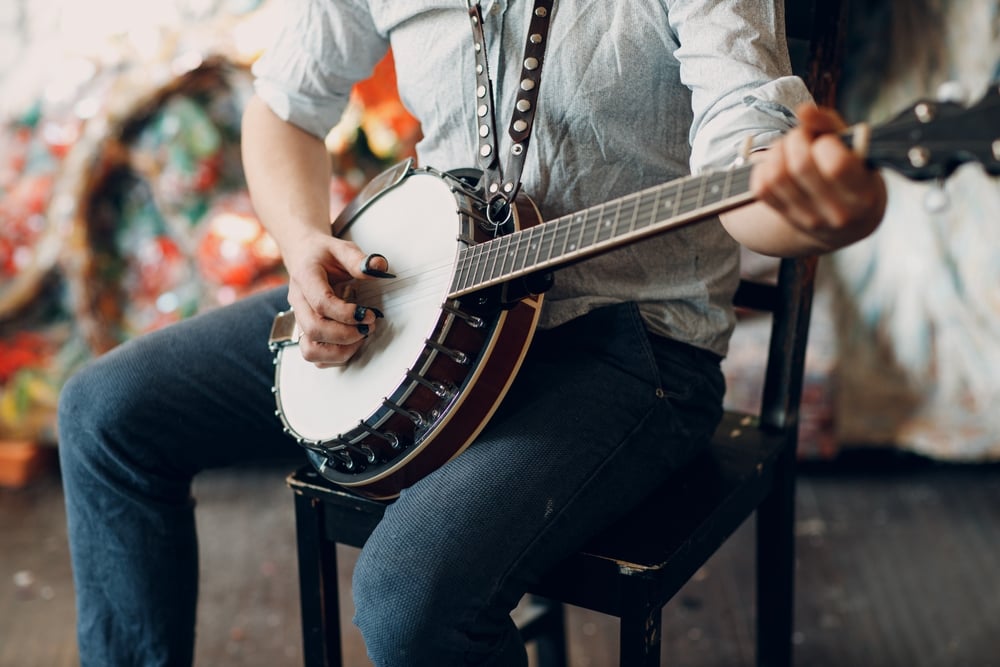
The banjo is an instrument most people know from one single scene in one film and then do not hear again for years. Yet it is recognisable within two seconds, and it is one of the cheapest ways to play something at home that sounds nothing like a guitar. It has a metallic, ringing tone that carries across a whole room without amplification, and learning your first few things on it takes less time than you would expect.
What complicates matters slightly is that the banjo is not one instrument but a whole family. It can have 4, 5 or 6 strings and an open or closed back, and every one of those combinations is played differently and belongs to a different genre. So it is worth knowing what you actually want before you order one. Let us go through it from the start.
What complicates matters slightly is that the banjo is not one instrument but a whole family. It can have 4, 5 or 6 strings and an open or closed back, and every one of those combinations is played differently and belongs to a different genre. So it is worth knowing what you actually want before you order one. Let us go through it from the start.
What a banjo actually is
Unlike an acoustic guitar, which has a wooden top, a banjo has a stretched head, exactly like a drum. That is precisely why it sounds the way it does. The string sets the head vibrating, and a head moves far faster than wood, so the result is a sharp, cutting tone with a very short decay. There is no long ring the way there is on a guitar. Every note speaks and disappears, and that is exactly why fast runs on a banjo come across so clearly.
The head is held taut by a metal rim and a set of hooks around the edge, which is how the tension is adjusted. The tighter the head, the sharper and louder the tone. Better instruments also have a tone ring sitting under the head, a heavy metal ring that adds body and sustain to the sound. The tone ring is one of the main things separating a cheap banjo from an expensive one, and also the reason a proper instrument has some weight to it.
How many strings your banjo should have
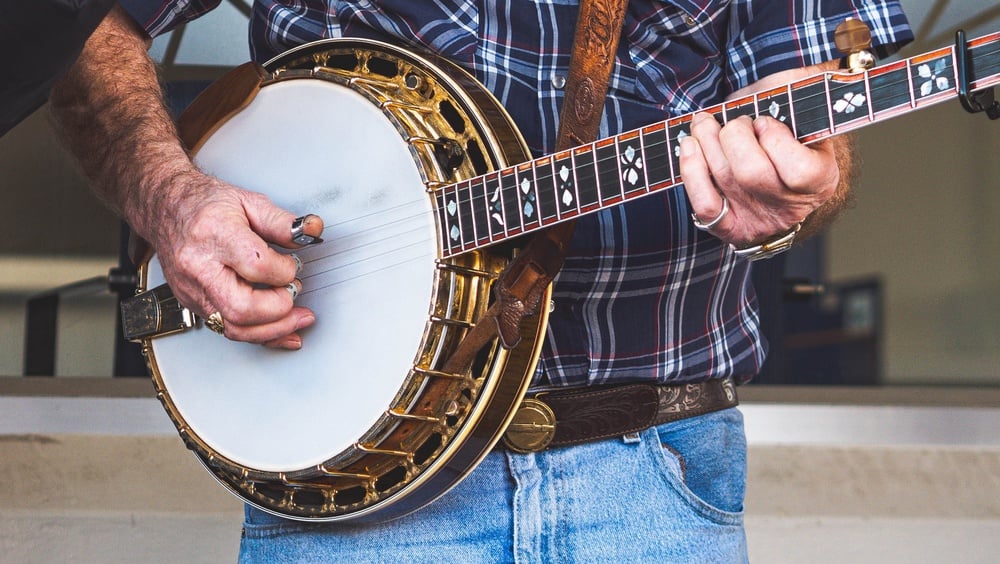
The five-string banjo is the classic one, and probably the first that comes to mind. You recognise it by the fifth string, which is shorter than the rest, starts at the 5th fret and has its own tuning peg set into the neck. You do not play melody on it. It simply sounds the same all the time and works as a drone, and it is exactly what gives the banjo its distinctive chiming character. It is played from tablature, with the right hand working in so-called rolls, fixed picking patterns across the strings rather than strummed chords as on a guitar. If you want to play bluegrass, country or old-time, this is the only right choice, and from our range that means something like the SX BJ405 or the resonator Pasadena 01BJ001.
The four-string banjo comes in two shapes, tenor and plectrum, and it is played with a pick. It has no drone string, so it sounds a little more conventional, and it lives in completely different music. It plays melody rather than chords, and it is read accordingly: in Irish traditional music from standard notation or by ear, while in dixieland and 1920s jazz from chord charts. If that is the direction pulling at you, take a look at the SX BJ404.
The six-string banjo is a bit of a cheat and at the same time the most sensible thing for anyone who already plays guitar. It is tuned exactly like a guitar, so you pick it up without learning a single new shape and get the banjo sound for free. You read ordinary guitar tab and chord symbols with it, so there is nothing new to learn at all. You will not pick up real banjo technique, but if you simply want to add a different sound to the band, this is the fastest route. We stock the SX BJ406 and the bluegrass Stagg BJM30.
Resonator or open back
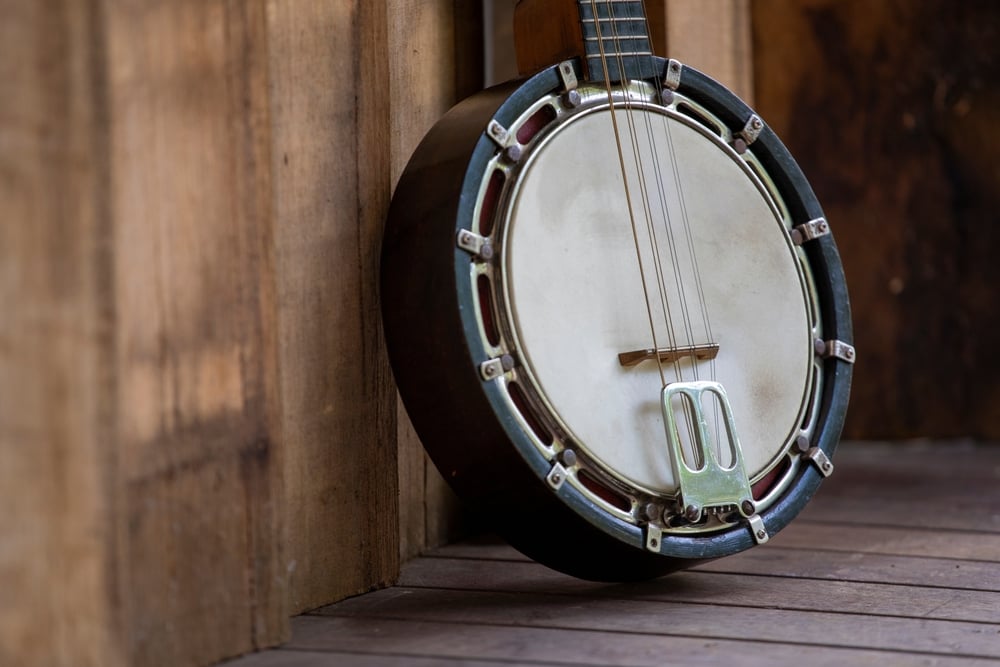
The second big decision is whether the banjo should have a solid cover on the back, the so-called resonator. It is a plate bolted to the back of the pot, and its job is to throw the sound forward, towards the listener. A resonator banjo is therefore louder and sharper, which is exactly what you need in a bluegrass band, where you have to cut through fiddle, mandolin and upright bass. Most of the instruments we stock, including the Pasadena 01BJ001 and the Ortega OBJ150-WB, are resonator models.
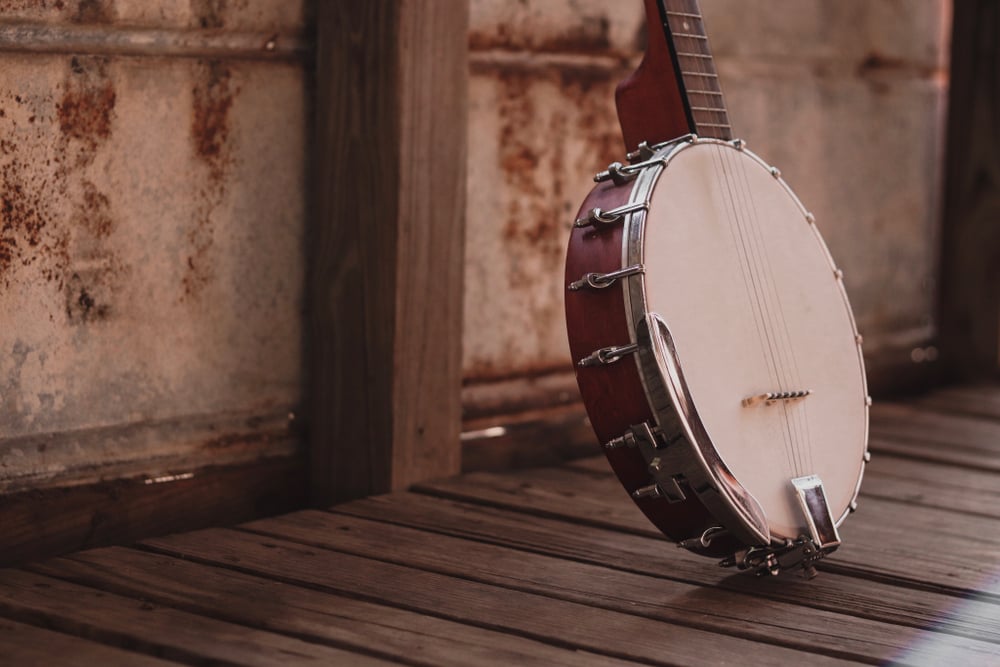
An open-back banjo has no resonator, so it is quieter, warmer and considerably lighter. It is the instrument for clawhammer, the old American downward striking style, and it is the choice for playing at home, on the porch and in a small line-up. It is usually set up differently too, with a higher string action over the frets, which suits that striking hand. If old-time music appeals to you more than racing for speed, it will suit you better, and your shoulder will thank you after an hour of playing.
What to look at on the body and neck
With the head, nearly every decent instrument uses a Remo head, which is good news, because it is a proven standard and cheap to replace. Also look at the number of hooks around the rim, because it is a reliable indicator of the instrument’s class. Cheaper models have around 16 to 18, better ones 24 and professional ones 30, like the Stagg mentioned above. More hooks means more even tension across the head and a more stable tone.
On the neck, look at what the fingerboard is made of. Rosewood is the standard and you will find it even on cheaper models, which is fine. More important is whether the neck has an adjustable truss rod, the bar that lets you straighten the neck once it bows over time. Without one, the instrument becomes hard to put right after a few years. Every model worth considering has one, but on the cheapest second-hand finds it is worth checking.
What it costs and what you get for it
In the entry class you get a working instrument with a Remo head, an okoume or mahogany body and a rosewood fingerboard. You can play anything on it, it will just be a little quieter and the tone will not have as much body, because it lacks a proper tone ring. For starting out that is perfectly enough, and it is a sensible way in if you are not sure the banjo will stick. Browse the cheapest banjos for an overview.
The mid class brings more hooks, heavier hardware and above all that tone ring, which you hear immediately. The instrument is louder, fuller and holds its tuning better, which matters more on a banjo than on a guitar, because a stretched head reacts to both temperature and humidity. This is where brands like Ortega and Pasadena sit.
And once you know the banjo is going to stay with you, it is worth looking higher, where you are mainly paying for build accuracy and for metal. You will find the full range across all price points in the banjo category, which also carries SX, Stagg and Ibanez.
5 things about the banjo you probably did not know
1. A five-string banjo is tuned to open G, which means that if you strum across all the strings without fretting anything, you get a clean G major chord. That is precisely why you can play something usable on it 10 minutes after taking it out of the box.
2. That short fifth string is neither a manufacturing fault nor a way of saving material. It is a drone string that sounds the same regardless of the chord, and it is exactly what creates that recognisable banjo chime.
3. The banjo has African roots. It was brought to America by enslaved people from West Africa, where instruments with a dried gourd body and a stretched skin were played. Only much later did it become a symbol of American rural music.
4. The modern bluegrass style was invented in the 1940s by Earl Scruggs, when he came up with playing on 3 fingers instead of the downward strike used until then. His technique is still simply called Scruggs style, and it is the reason the banjo sounds so fast in bluegrass.
5. Before amplification arrived, the banjo was the loudest string instrument in the band, and that is precisely why it sat in the first jazz orchestras instead of a guitar. Once microphones and electric guitars came along, jazz moved to the guitar and the banjo retreated into folk.
What else to buy with it
The first thing is strings, because the ones that come on a cheaper instrument are usually nothing special, and swapping them for a decent set does more than you would expect. The second is a spare head, not straight away, but expect it to stretch out over time. It is a consumable, much like strings.
Next you will want a tuner, even more so than with a guitar, because a banjo drifts out of tune faster. A capo is useful too, but watch out, a banjo needs a narrower one than a guitar, and the fifth string is handled by a separate capo of its own. And because a banjo has protruding hardware that scratches easily, get a gig bag or a solid case along with it.
It is worth knowing what you are getting into here. The banjo is not learned from standard notation but from tablature, which instead of pitch shows you the string and the fret directly, and on a five-string also which finger picks it. If you already play guitar, this is familiar territory and you will move across without trouble. We also stock methods for complete beginners that walk you through techniques like hammer-ons, slides and pull-offs, which is exactly what banjo playing is built on. And if you are starting from zero with reading music, How to read sheet music will help.
So which one should you pick
It mostly comes down to what you want to play. For bluegrass and country, go for a five-string resonator banjo, which is also the most common choice and the one with the most learning material available. For old-time and playing at home, pick a five-string open-back, quieter and lighter. For jazz and Irish music, reach for a four-string. And if you already play guitar and just want a new sound without starting over, take a six-string. You will be up and running in a minute.
If you still cannot decide, that is fine. The banjo is one of those instruments worth picking up in person first. Put a resonator and an open-back side by side and 5 minutes will tell you what no description can. The full banjo range is a good place to narrow it down, and if this is your first instrument of any kind, A guide to the families of musical instruments will help too.