 Albania
 Argentina
 Australia
 Austria
 Belgium
 Bosnia and Herzegovina
 Brazil
 Bulgaria
 Canada
 Chile
 Colombia
 Croatia
 Czech Republic
 Denmark
 Estonia
 Finland
 France
 Germany
 Greece
 Hungary
 Ireland
 Italy
 Latvia
 Lithuania
 Luxembourg
 Mexico
 Moldova
 Montenegro
 Netherlands
 New Zealand
 North Macedonia
 Norway
 Philippines
 Poland
 Portugal
 Romania
 Serbia
 Slovakia
 Slovenia
 South Africa
 Spain
 Sweden
 Switzerland
 Turkey
 Ukraine
 United Kingdom
 United States of America


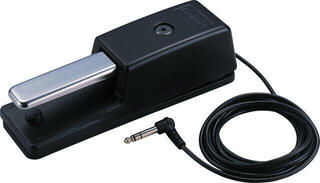
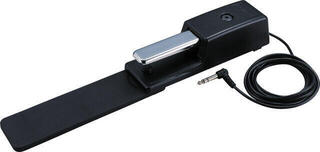
Roland Sustain Pedals
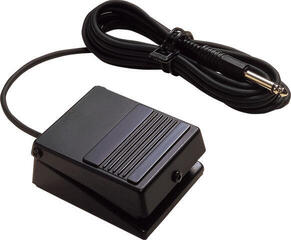
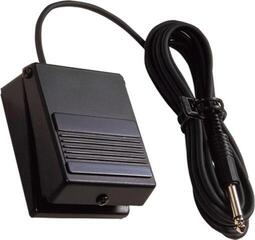
Connect a Roland sustain pedal to a digital piano, stage piano, keyboard or synthesizer to let played notes ring out after you release the keys, much like the right-hand pedal on an acoustic piano. Roland has two models in this category: the DP-10, with the shape and action of a piano pedal, and the compact DP-2 footswitch. Both are passive, need no batteries or power adaptor, and connect to the instrument through a single cable with a 6.3 mm jack plug. The difference is whether the pedal recognises only on and off positions or also supports half-pedalling.
Roland DP-10 or DP-2: which sustain pedal should you choose?
| Feature | DP-10 | DP-2 |
|---|---|---|
| Shape | piano pedal with a long lever | compact footswitch |
| Half-pedalling | yes, if supported by the instrument | no, on and off only |
| Connector | 6.3 mm stereo jack | 6.3 mm mono jack |
The Roland DP-10 is a choice for pianists: the lever feels similar underfoot to an acoustic piano pedal, and its cable is 2.2 m long. A switch on the pedal body lets you choose continuous mode, in which the instrument reads intermediate positions, or simple switching. You can rotate the rubber plate out beneath your heel to keep the pedal from sliding across the floor as you play.
The Roland DP-2 is a small, light footswitch that is easy to pack alongside your keyboard for a rehearsal. Besides sustain, the manufacturer lists other uses, such as starting and stopping recording on Roland and BOSS recorders.
Will a Roland pedal work with your keyboard?
Sustain pedals differ in polarity: the switch can be either open or closed when at rest. Neither the Roland DP-10 nor the DP-2 has a polarity switch. If the instrument expects the opposite polarity, sustain works in reverse: notes ring out with the pedal released and stop when you press it. Some instruments detect polarity automatically at power-on or offer it as a setting, so check your keyboard's manual to find out which pedal its input supports.
Half-pedalling needs two things at the same time: the DP-10 pedal set to continuous mode and an input on the instrument that can read intermediate positions. If the instrument cannot read them, switch the DP-10 to switching mode and use it as a conventional sustain pedal.
How does sustain differ from an expression pedal?
A sustain pedal holds played notes, while an expression pedal continuously changes the volume or another assigned sound parameter. Each connects to its own input on the instrument. You can find continuous controllers on the Roland Keyboard Expression Pedals page, and all the brand's pedals together on the Roland Keyboard Pedals page.